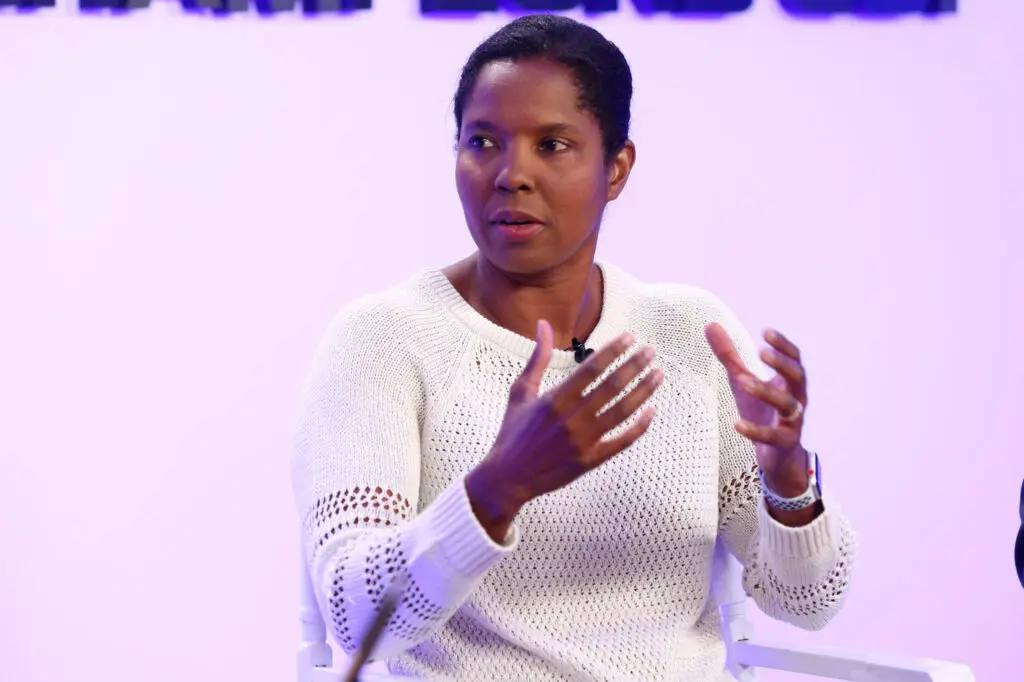
Briana Scurry is ready to tell her story.
The former U.S. women’s national team goalkeeper’s new memoir, My Greatest Save, launches on Tuesday.
Scurry has left a legacy as one of the best goalkeepers in the world, setting the standard for what the U.S. women’s national team is today. After being named the country’s starting goalkeeper in 1994, she won her first gold medal at the 1996 Olympics in Atlanta, where women’s soccer was played at the Olympics for the first time ever. She went on to lead the U.S. to their 1999 World Cup title with a game-winning save in the championship shootout. In 2004 she won her second Olympic gold.
Then a knee to the head left Scurry with severe trauma in 2010, putting a devastating end to her historic career. Unable to work, Scurry spiraled into debt and depression that almost led to suicide.
Scurry sat down with JWS for a Q and A ahead of the release of My Greatest Save, a story about resilience and redemption.
Your wife Chryssa inspired you to write this book. Can you talk a little bit about what those conversations looked like?
I think what’s interesting about my amazing wife Chryssa is that she has been so instrumental in the resurrection of my career as a whole. This book is literally a labor of love, and I was finally ready to write it. I decided in the beginning, when we started talking about potentially doing this, that I needed to sit with the idea for a while because I needed to feel like I could be authentic about all of my life, not just about the really cool stuff that’s happened, but also some of the really uncool and hurtful and painful and sad parts of it. Was I ready to really be authentic and telling that to folks? Because I’m an incredibly private person normally, so it’s a little ironic that I’m writing this book that is so in my mind, in my head basically, on a piece of paper.
So, I said to her, “I need to sit with it, the idea. I like it. I like the idea, but I need to make sure I’m far enough away from some of the stuff that’s happened to be able to look at it and go back to that feeling space of it to be able to tell it well.”
Was there a specific moment where it hit you that you were ready to write your book?
Yeah, actually, there was. I was really thinking about my parents and telling, essentially, the story about being in the room when my dad passed. I’ve told people that story, but I really had to be able to tell it greater, in the grander, get down to it. As I was thinking about it, I realized that, yeah, I felt I could do that and I could honor the time as opposed to just skimming over it or making reference to it but not really getting in the weeds on it. So, I realized that. As soon as I realized that I was ready to get in the weeds on these things. Then that’s when I said, “OK let’s do it. I’m ready.” Because if I wasn’t ready then I would have said, “No, maybe not now.”
What messages do you hope people take from your story?
My purpose in life has always been to create and to inspire. I’ve done a lot of creating through my journey to winning an Olympic gold medal and playing on the national team for Olympics and World Cups and inspiring millions of people doing that with my team. I wanted my book to be an inspiration, also, to people who read it, truly to have them see that success is not a straight line, that we can make gains and then sometimes lose them, but you can always rise up. You can really be in an absolute horrible situation and still find a way to make it better, to continue to take a step forward, even if it’s just the smallest thing of, “I’m going to make it till tomorrow.”
The reason you keep going is because you don’t know where help is going to come from. I think for me during the time of my concussion, I really learned that. You know, Naomi talking to Chryssa in a dinner meeting, and then literally changed my life, and I wasn’t even there. I think the message there is just keep going, keep believing that change can come. You really don’t know where it’s coming from, and all of a sudden there it is for you.
I am excited to announce my upcoming memoir, My Greatest Save.
— Briana Scurry (@BriScurry) March 2, 2022
Many know of my @USWNT career, but few know of the brain injury that caused my deep depression or of my long journey to recovery.
On 6/21, I am proud to be able to share my story with you: https://t.co/vEhOeeEVzi pic.twitter.com/gxajJY81TJ
While you were writing the book, which part was your favorite to relive?
I think my favorite was probably the ‘96 Olympic Games because I literally went from being an eight-year-old girl who watched the Olympic Games and the ice hockey team in Lake Placid. [Goaltender] Jim Craig, all the guys just do the impossible made possible by beating the USSR. That was the beginning of that dream, and then ‘96 was the culmination of it becoming real for me.
So, I would say that was the greatest part to retell because it was so much fun and we were like kids — at least I know I was, like a little girl in getting my gear and getting to walk in the parade when we came into the field on the opening ceremonies. I mean, my heart exploded out of my chest, coming around the corner. Talking, reliving all of that pageantry, if you will, and the adventure of it. I was so young then. I was so hopeful, and I had everything right at my fingertips. My world was at my feet, and that was a really fun time to talk about.
Did reliving your story make you wish you had done anything differently?
You know, it did. I think the one thing that is so clear to me is I wish I had talked to my parents more about them. Not about me, or about what I was doing, or what I was feeling or what I was wanting, but to talk to them more about who they were.
For example, in the part of the book where we talk about how my parents met, obviously I wasn’t born at that point, so my brother Ronnie helped a lot in the retelling of how my parents met. Reading that and writing that just made me feel a little bit of regret that I didn’t — I don’t know, I just have a new outlook and a different perspective on things now that I have stepchildren and it’s like well, how would my mom and dad have handled this or that? It would have been neat to ask them what they thought and what they felt, so that’s one of the things I would say.
If little Bri read your book, which part would she be most excited to read about?
I would think that she would be excited about how I turned the tables and completely resurrected my career after 2000 going into 2004 and the way that I handled the situation with my dad and all of that. I would think that as me now, but I think little Briana would probably just love reading about the Olympics in general, like all the game stuff, the game commentary and retelling of how the game went and maybe watching that game for herself for the first time, similar to how I watched Lake Placid, the ice hockey team, just watching the games on TV over again. I think that’s the part she would like the best.
Knowing what you know now, what piece of advice would you have given the young Bri who was in the early chapters?
Advice is tricky because part of me wants to say be more present and be more open and absorb the present and everything around you, but as a high-level elite athlete, I think a lot of athletes would say that you really have to be focused on the task and you narrow your focus. And to be more the moment sometimes requires you to broaden your focus, and so that’s not necessarily advantageous. You know what I mean? You sometimes have to block things out in order to be able to do the thing well. So, I would say, just have more fun with it, I think would be what I would say, because you can’t have more fun with it and have a really narrow focus still.
Was there anything you learned throughout the process of writing your book?
I actually heard this this morning when I was listening to GMA that the author of a book said it was cathartic to write it. One of the ways I look at it is there’s all these rooms of memories that you have, or moments or a couple days or this or that or an Olympics, for example. There are situations in that room and the difficult times that are hard and hurt you or are sad, you put them in a room and you lock them away. You put them on the shelf. You often don’t ever go back to that room. What happens, I feel, somewhere in your body, you have unresolved emotional baggage in that room, and if you don’t go and resolve that baggage then it’ll always be there. And it could be something that’s holding you back from becoming better or moving on through something.
I think the book required me to pour sunlight in all the rooms that had darkness in them. Going through that with the light and being honest and truthful with myself, I was able to have forgiveness in a forgiveness space of all those rooms that needed it. Had I not done the book, I wouldn’t have had that to be necessary, it wouldn’t have been required to me for me to do that. I think it really enlightened me and also really made me more appreciative and grateful about the amazing life I do have now because when I went back to some of those things, I’m like, “Wow, Bri, you must have been really hurting at that time,” almost like I was looking at it like it wasn’t me. Then saying, “OK well, you can have forgiveness.” You can forgive yourself, you could forgive that person or that thing or whatever. You can be at peace with it.
I think with the book, with book writing, that’s what happens, but I wasn’t aware that was going to happen to me.
Was it difficult to get through writing about those tough times in your life?
It was, yeah. There are two in particular that were really difficult.
One was being back in the hospital room when my father passed. Having to really think about that and remember that moment and be able to describe it in the book and to get the reader to the feeling space of how I was then and how that felt to me, to have my father be there. He was also my first parent that passed. Everybody is aware that normally a child outlives a parent. The odds of me actually being in that room were astronomical. I found myself there and understanding all of that is a bit cosmic, really. It’s hard to comprehend it.
Then also getting into the feeling space of when I was suicidal. What would happen would be Wayne [Coffey, co-author] and I would talk about this, and I would tell him how it felt. And we would talk and talk and talk about it, and then afterwards when we were done talking about it, it was still on me, that heaviness. I would go through my next day or two wondering why I feel so glum, even though I’m incredibly optimistic. That was hard to almost have that weight and relive that, literally. I did believe that, in order to be able to tell it well in the book and have you understand and feel that way and at least get a glimpse into what that was like for me.
Were you able to relieve that weight that you carried after those conversations?
Yeah, I did. I would talk to my wife Chryssa quite a bit about it. I found that when I would tell her about what I talked to Wayne about that day, talking to her helped remind me that that was my past. Although that sounds very strange that I wouldn’t know that, it’s almost like she checked me back into my current life, my present. I felt like I was almost dishonoring, maybe to a level, if I stopped feeling that way about my dad dying or when I was suicidal. I realize that I’m just trying to help other people with it and that it’s OK to leave it there, because I can’t fix it. What I can do is I can fix myself on how I feel about it, and that’s exactly what I did. I would visualize myself opening the shades, opening the door, letting the sunlight into that space, and that was able to help me be able to move onto the next thing and be OK with that.
The title, My Greatest Save, is obviously a metaphor, so what’s your greatest or favorite save on the field?
It’s interesting because the PK save in ‘99 isn’t actually my greatest save, in my opinion. Looking at that, most people would obviously think that, but I feel like the save I made in the 2004 Olympic final against Brazil when Cristiane literally ripped one from 18 or 16 yards out to the corner and I literally just threw my body and fingertips, barely got that ball and spun it around the post. I remember not seeing it, I didn’t actually see the shot. I just went and that’s that being in the zone thing that Athens talk about a lot, and at that moment I felt like I was in the zone. My body, my mind was playing the game with my body. I wasn’t really conscious of everything going on in that game, and it just felt so instinctive. I would say that save was my greatest save on the pitch because if I don’t make that save and Brazil scores, the tide of the game can change quickly, especially with a team like Brazil. When they score, they often pour them on you — goal after goal after goal. Making that save made me know that I was ready.
Do you have any thoughts on the current USWNT roster that was recently announced?
Yeah I do, and I kind of have to because I’m actually on the studio team for the qualifiers with CBS and Paramount+. I’m actually going to be broadcasting that tournament. I thought it was interesting, Vlatko [Andonovski]’s press conference after the release. His answer about Christen Press, I thought was… I’m like, “Mmm?” I thought it was odd.
It made me wonder, and we talked about it on the call, about Vlatko. Vlatko’s going to be a topic of discussion, I believe, going forward with regards to his choices. He’s got a lot of pressure on him, and obviously he’s got a whole year until actually coaching the World Cup tournament itself. But this is going to be an indicator of his philosophies. I just didn’t think that was handled very well. You can make decisions that are really tough like that, but you can also handle it better, I thought. I was wondering why he answered the way he did.
Macario’s out, unfortunately, with her knee just like a minute ago, virtually, and so he was building that team around her essentially. Now, what does that mean? How do you take out a foundation, literally half of it, and then reconstruct it and then make it again? I feel like that’s a topic.
Then the idea of playing Mexico might end up being a real challenge because apparently from what I heard that the game is sold out, or on the verge of it — the third game against Mexico. That’s really intriguing.
I just feel like the current team is going to be fine with the qualifying, but I think it’s going to be interesting. It’s so funny because every time we have a cycle, a World Cup, we always have the same questions, and they always have the same answer: “Don’t worry about it.” Like we did when I played, all these people have all these questions and no power to make an impact on the outcome. I find that intriguing about being a talking head that if I were listening to me, I’d be like, “What do you know about it?” [Laughs] But it’s fun. I enjoy it. So that’s how I look at it. A lot of interesting points to the youth of the team. I mean, half the Washington Spirit team is on that roster, basically. That’s interesting because just two years ago there wasn’t any Washington Spirit players because we didn’t have O’Hara, we didn’t have Sonnett. Andi hadn’t come through yet. Now Aubrey’s on there, obviously Trin’s on there, Sanchez on there. I mean, half the lineup is in that camp now, so it’s going to be interesting.
In light of your book being released during Pride Month and as the only Black lesbian on your team, how do you hope soccer will continue to become a more inclusive space?
What’s interesting about change is it moves like an iceberg. A glacier is very slow, but you always have to keep pulling or pushing or asking and talking about it. You have to keep going and going.
I feel like we’re getting there because the 2015 World Cup, there is a real monumental image from there that was Abby and her wife at the time, Sarah, embracing each other and kissing each other after the game. That image was very reminiscent and replicative of the World Cup. In my time, in ’99, I was running to the stands to my girlfriend and the camera was following me and then it cut away as soon as they realized it was a girl. We’ve come a long way from that, from cutting away to being an iconic image of the World Cup in 16 years, but there’s still room to improve. There’s always going to be. Not only sexual orientation, more inclusion that way with the team, but also more Black girls on the team that are playing in the games that matter — World Cup rosters, Olympic rosters, this roster, for example — getting into the game and making an impact. Crystal Dunn is the only example I can think of that has had any real consistent impact on high-level, high-stakes rosters.
There is some improvement to do but it’s coming along. I was overjoyed to hear an interview that Abby did for my documentary, The Only, that’s coming out on July 12. CBS Paramount+ is doing that. She said that seeing me be out on the team helped her and Megan Rapinoe be who they are later on. That was really cool. I didn’t know that she felt that way about it, so that was really nice to hear.
So yeah, keep going, keep making an impact, keep talking, sharing your truth with people. You can really make inroads, you can make progress, you can help other people, for example. Equal pay is another great example. Thirty years it’s taken to get that done. The cool part is one of my former teammates is really instrumental. Cindy Parlow Cone is the president of the federation and getting that done, so we’re getting there, but we still have work to do.
How does it feel to see the progress with the equal pay settlement that was recently announced between the USWNT and U.S. Soccer, being one of the original players who started that when you and eight others sat out of the ’96 Olympic training camp?
I was absolutely thrilled when that news dropped. That was a fantastic day. It was a journey that was so long, alongside of my own journey to become me. Part of the national team, if you play for the women’s soccer team, part of your mandate is to raise the bar for equal pay, and the other part is obviously to play brilliant soccer and win everything. Those are two really high standards to hold. This current generation has done a phenomenal job of pushing that bar up and putting their necks on the line with the lawsuit a few years back that was a new iteration of that journey to get equal pay. That was just the next step that had to be done in order to get there.
Like I said earlier, you just have to keep pushing, pushing, pushing. They finally were able to do it, largely in part, I think, because one of us became president. Hats off to Cindy Parlow Cone, obviously hats off to the men’s team for being willing to come to the table. Walker Zimmerman was very instrumental in getting the guys on board with the idea of pooling the prize money.
And never mind about the revenue sharing. That’s brand new, that’s amazing. I feel like what you’re going to see in the next few years is that revenue from outside sponsors, partnerships, broadcasting rights is going to grow into enormous pie because, in part, a lot of companies are probably going to be like, “I don’t know if I want to be a part of U.S. Soccer because they’re not really being fair to their women’s team, and it doesn’t feel right, it seems weird, it doesn’t smell right,” but now we’re all on the same page, playing together, for each other, and I think that’s going to make a huge difference in the near future.
Jessa Braun is a contributing writer at Just Women’s Sports covering the NWSL and USWNT. Follow her on Twitter @jessabraun.