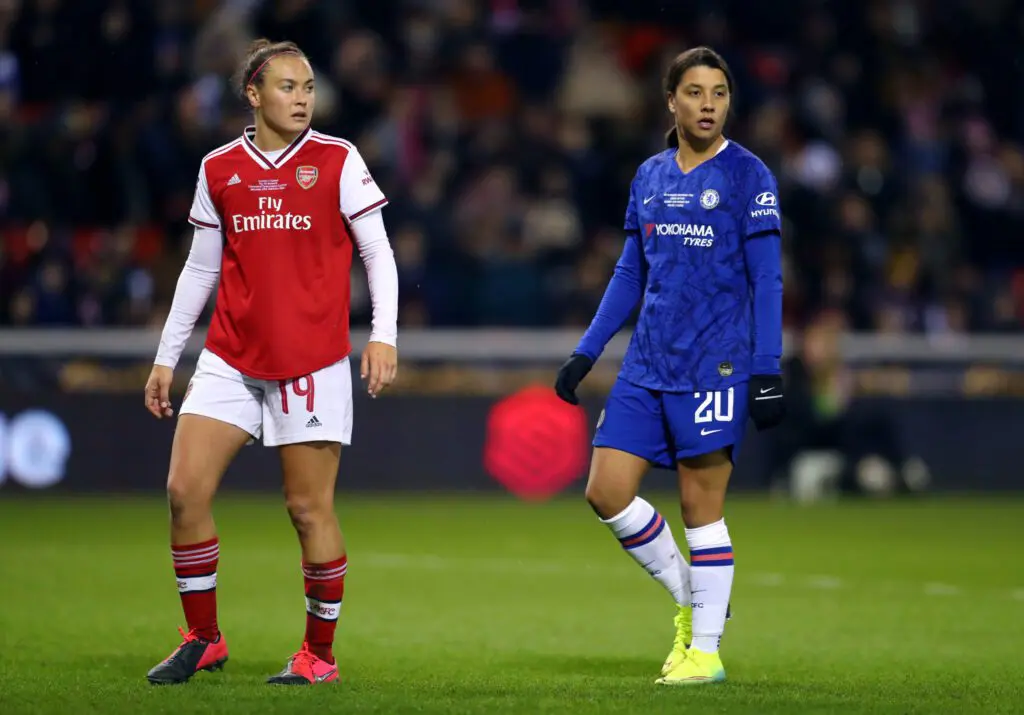
Caitlin Foord plays for both Arsenal and the Australian national team. In 2011, at age 16, she became the youngest Australian to play in a World Cup. She has since played in three World Cups and the 2016 Olympics. Below, she spoke with Just Women’s Sports about her rise in the W-League, her time in the NWSL, and what comes next for the national team.
[Editor’s note: this conversation took place shortly before the FA announced that the Women’s Super League season would not be restarted amidst coronavirus concerns.]
You started playing in the W-League when you were 15 years old. What do you remember of those early years? Were you ever intimidated?
To be honest, at the time it was a big deal because the W-League was new. When I look back at the W-League now, the league has come a long way. It’s still not professional — it’s semi-professional, but it has improved a lot. Back then, we were training out of high school and I wasn’t too intimidated because I had been training with those same girls for a couple of years before through the state program. Getting brought into the state program was definitely intimidating though because that’s the first time you would train with those older girls.
Things were different then — the older girls didn’t make it easy for the young ones to come in. You had to earn your spot. At times that was intimidating, but I don’t think I had a difficult time because I showed them respect and then, when I played, I earned that respect back.
After you signed with Sydney FC, you got your first call up to join the national team. What was that experience like?
When I joined the national team, it was pretty scary. At the same time, though, Sam Kerr, Emily van Egmond and Teigen Allen were all on the team and around the same age. They were some of my really good friends, so it was easier to join the team with them there, too. It was intimidating, but I had my group of friends.
Then, the team went to the Asian Cup qualifiers for the World Cup. I had been going to the training camps leading up to the qualifiers, but I missed out on that squad. The team ended up winning the Asian Cup and I just remember watching that and really wanting to be there as a part of the win. It was the first ever for Australian football, and it was disappointing that I wasn’t there to experience it with them.
Was that disappointment motivating? What happened that led you to being included in the World Cup roster?
I didn’t really expect to go to the Asian Cup with the team — I wanted to, but I didn’t think I was there yet. But, leading up to the World Cup, I was going to the training camps again, and I remember one specific camp where it was getting close to when the squad was going to be picked. And, I should say, I was pretty oblivious when I was younger — I didn’t really take note of certain things. At this camp, there was one game against a boys team and my role was to follow this one boy around the field for the whole game. So, I just said, “Okay, that’s my role.”
The girls were all saying to me, “You’re going to get picked for the team.” And I was so confused. How did they know? They kept saying, “It’s because we’re going to play Brazil in the first game and someone’s going to have to man Marta, and it’s going to be you.” And I thought there’s no way. But then at the final camp, I got a call from Tom Sermanni, who was the coach at the time. He told me that I was going to the World Cup, which was crazy.
I didn’t grow up with football in my family, so even though I knew it was a big deal, I didn’t know just how big of a deal the World Cup was. My family and friends were really proud of me and excited. But, for me, it was just like, “Cool, I get to go on another tour with the girls.”
There’s a lot of girls that were on that team that are still on the national team.
Yeah, I think we had the youngest squad or the second youngest squad there. It was me, Sam Kerr, Kyah Simon, Lydia Williams, Emily van Egmond, Tameka Yallop, and Clare Polkinghorne. Sam and Emily and I have been on the journey from the beginning together. They’re two of my best friends. We’ve grown up together and experienced a lot together — the highs and lows, the injuries.
You were named “Best Young Player” at the 2011 World Cup. What was that experience like?
Well, I did end up starting our first game against Brazil in March — marking Marta. I went on to start in three of our four games, I think. I had a really good tournament and just happened to win the Best Younger Player award. I was still so oblivious to what was going on. After we got knocked out, I went on holiday with Sam and her family. So, I was in Croatia on holiday when I started getting Facebook Messages saying congratulations for the award. Then people from the Federation called me and told me that they wanted to fly me back to Germany for an award presentation. I just said, “No, it’s okay. I’m actually on holiday at the moment.” Looking back now, I really should have gone. But at the time, it didn’t really phase me. I was like, “Oh, that’s cool, but I’m having a much better time on holiday.”
In 2015, Australia had a good run but still looked like a team on the rise. In 2019, Australia was definitely a force to be reckoned with, but had a disappointing finish. How has the national team changed throughout the years? What’s the state of the team now?
In the 2011 World Cup, we had a super young team. We were there to compete, but there was never a belief that we were genuinely going to be winners. And then in the 2015 World Cup, we started competing with the big nations. We knew that we had the team to be able to go far, but I think what was missing was the belief within the team that we could be winners. In 2019, we felt like it was our time, which is what is most disappointing. I’m not going to make excuses for us, but I think the timing of our coaching staff being fired four months before the World Cup wasn’t good for us. It was a difficult situation to overcome, and I think we did the best we could in that position.
After we were knocked out of the World Cup in 2019, we just wanted to play another game so we could move on. We wanted to leave the World Cup behind us and focus on the Olympics. Now with our new coach, we take our hats off to what he has done with us in the short amount of time he’s had. He’s taking us through to the Olympics as well. Although they’ve been postponed, we’re excited and feel like we are genuine competitors to medal.
You were only 18 when you moved to the US to play for Sky Blue in 2013. What led to that decision and how was that transition?
Once I finished school, I didn’t really know what to do, and everyone on the Matildas was going to play overseas. I signed with Sky Blue through Lisa De Vanna, who was there as well. The team was looking for an outside back, and she put my name forward. Sam went to play for Western New York at the same time, so, as daunting as it was, I knew that I had her and Lisa.
It was definitely scary. I hated it my first two weeks. I was in New Jersey and the house I lived in was old and not very nice. I kept thinking, “What am I getting myself into here?” But once I started training with the team and making friends, I loved it.
I had to grow up pretty quick, though. I didn’t even know how to cook when I moved. Luckily, Danesha Adams was one of my roommates and she took me under her wing. She always cooked dinner for me and took care of me. And when it was time for me to leave during the offseason, I was really upset because I loved it so much. I was obviously excited to get home, but I was sad to leave the friendships and the life I was living over there at the time.
Looking back, how would you characterize that time with Sky Blue and that first stint in the NWSL?
During my first couple of years at Sky Blue, we had a good team, and I loved it. I had the opportunity to play alongside Christie Pearce, who was still on the USWNT. I learned a lot playing next to her. I don’t even know how to describe her — she was just incredible. There always used to be this joke where she would say, “I’m old enough to be your mom.” I was closer in age with her eldest daughter than I was with her. She took me under as one of her kids and I became really close with her family. She was someone that took care of me. I actually called her my US mom.
After those first couple years, though, I wanted to be traded. As I’m sure you are aware, the organization was not the best at the time. I wanted to get out of there, but they wouldn’t trade me.
This happened in the year leading up to the Olympics, so since they wouldn’t trade me, I decided to stay in Australia and focus on training for the Olympics. If it had been any other year, things probably would have been different. But, that’s where my stubbornness comes in. I knew I didn’t want to go back to play for Sky Blue. I was hoping that if I didn’t come back, they would just trade me and I could play somewhere else. I think they were hoping that if they kept refusing to trade me, I would give up and come back. It didn’t work like that for either of us. The following year, I wanted to be traded again but they continued to refuse.
After two years of requesting a trade, why wouldn’t they trade you?
Honestly, I don’t know. There are so many rules in the NWSL, it’s crazy. When they wouldn’t trade me the second year, I went and played in Japan for a season. It was a completely different experience, but it was also a small world. The goalkeeper I played with at Sky Blue, Brittany Cameron, also played in Japan at the time and she is who first got me interested. It was a new challenge, but I learned so much from being there. My style of play adapted. They are so technically good in Japan, that I was able to improve a lot playing alongside them.
After playing in Japan, you ended up being traded. How did that come about?
The following year, I started working with a new agent in America. He finally got me traded out of Sky Blue and got me to Portland. He asked me where I wanted to play and I said anywhere. He said, “No, you have a decision in this. You can choose.” That was shocking to me. I just wanted to get out and now you’re saying I can choose where I play? That was cool. He asked what my first preference was and I said, obviously, Portland. Somehow, he made it happen.
Why do you think it took having an agent to actually get you traded from Sky Blue?
Honestly, I don’t know. It never made sense to me. I was out of the league for two years, yet a team still owned me. It didn’t seem right to me. I guess that’s just how the league runs. You almost don’t have any power as a player.
How was the move to Portland?
I was so excited about the big move because I had wanted to be in the NWSL for the last two years. Right before the move, I was still playing with Sydney FC and we were going into the semifinals. I was playing well at the time and had scored in the first half of the game. Right before half time, I ruptured a ligament in my foot. I was out for three or four months, which delayed me getting over to Portland. That was super tough for me because it was something I was really looking forward to.
Once I recovered and made it to Portland, I was so excited to be there. I have to give massive credit to Mark Parsons and everyone at Portland because they really helped me get through that injury. Their support made me feel like part of the team even when I couldn’t play — it was incredible. But it’s always difficult coming back from an injury, and I felt like I did well with what they asked of me in the club, but I was disappointed because I felt like I couldn’t give them all that I wanted to even though I was so excited to play.
How did your approach change following that disappointment during your second year with the team?
That first year, I just didn’t feel like I could give to the club what I wanted to. Once the season ended, I was already excited for the next year. In my second year, we had three or four games before I went to the World Cup, and I was playing well. And then I went off to the World Cup to play for Australia. The league continued and credit to the other girls on the Thorns because they were playing really well. When I came back, it was a bit strange. I didn’t get the opportunity to play and prove myself. The team was winning. Players were playing well. It made sense to not take them out, but for me it felt like I was being punished for going to the World Cup. It’s still sad for me because I left Portland and I don’t feel like I gave as much to the club as I would have liked to.
You signed with Arsenal in January. Obviously, coronavirus has thrown a wrench in things, but how do you feel about the move?
The biggest thing for me right now is that I feel like I’m in a good place with my football and how I’m feeling since joining Arsenal. I’ve never felt so sure and right about a move like this before. The staff has really gone above and beyond. They’ve driven around and dropped off workout gear. There’s group chats where they send workout programs, and they are able to make it fun.
It was hard to be motivated at first, especially after the Olympics were postponed. I spoke to the staff here at Arsenal and expressed how I was feeling. They 100% supported me and understood where I was coming from. They said, “Don’t feel pressure. We’re not chasing numbers. At this point, everyone’s mental health is more important.” To have that support from the Arsenal staff has been super encouraging. It makes my experience so far at the club even better.
You’re 25 and have played in three World Cups. This will be your second Olympics coming up. You’re playing for arguably the best club team in the world. What’s next for you?
Oh, man. I don’t think I’ll be satisfied at the end of my career if I haven’t won or played in a World Cup Final or won an Olympic medal. I want to do something special with the girls I’ve grown up playing with. I would give all of my individual awards away for any of those team awards. Obviously, Arsenal is known for winning trophies and I’ve yet to win any with the club, so hopefully we can grab some of those. A Champions League trophy would be cool.