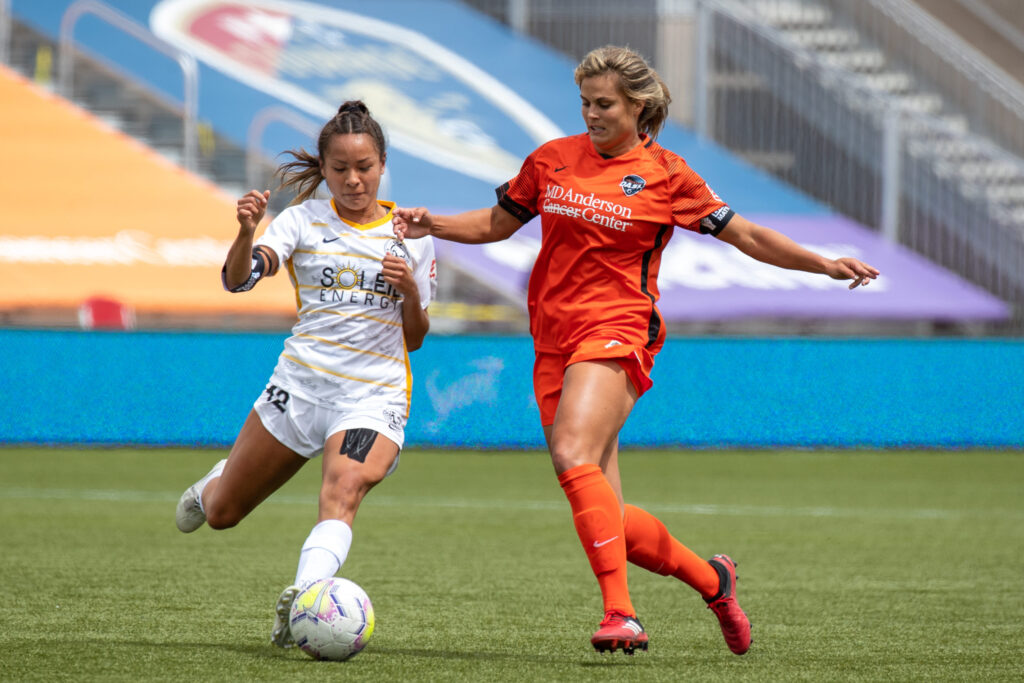
Katie Stengel plays as a forward for the Houston Dash of the NWSL. She previously played for the Boston Breakers, Washington Spirit, and Utah Royals, as well as Bayern Munich in Germany and both the Western Sydney Wanderers and Newcastle Jets in Australia’s W-League. A true international journeywoman, we talked to Stengel about her multi-league career, how the NWSL has changed, and what she’s learned along her professional journey.
This offseason, you were traded to the Houston Dash from the Utah Royals. How did this move come about?
Well, I was expecting to go back to Utah this year. And then, all of a sudden, I got hurt and I texted my coach, asking if we could chat. She never called me back and I later found out she took another job. My assistant coach was supposed to reach out to me to catch me up on things. I never got that call either. Instead, I got a 30-second call from our General Manager who said, “Hey, I just want to let you know you’ve been traded. Thanks for everything. Okay, bye.”
You know this league – they don’t really care. I didn’t know who to call or what to do. Not to mention, I was still hurt. So, I called the coach here in Houston and we talked about when I could come play.
Obviously you’ve been in quarantine for a lot of your time in Houston, but how do you like the city so far?
I love this city, it’s so fun. There’s so much to see and do. I’ve been to the rodeo at least 45 times. There’s bars and happy hours everywhere – it’s cheaper. People are Southern and have Southern manners. Everyone is friendly, but then also crazy. There’s parks and restaurants and coffee shops. It’s a good spot. I think I’m made for this city.
Small sample size, but how does it compare to your other NWSL experiences?
Houston’s been my favorite in terms of it’s a fun city. I get along with the players and I really like the coaching staff even though I’ve only been here for a little bit. Everyone always chirps on Houston, but it’s actually been amazing.
You’ve played in Germany and for three clubs in Australia. You’ve also played for the Washington Spirit, Boston Breakers, Utah Royals and now Houston Dash in the NWSL. How have your experiences compared across different teams and leagues?
Playing in D.C. was my first NWSL experience and I didn’t know what to expect. I thought everything was great, and I had fun. When I went to Boston, I thought, “Wow, this is a totally different experience.” We were in a real city and I thought the Plex as a facility was great. And then going to Utah, they put so much money into the program that it was great. I really appreciated that experience. And then here in Houston, I don’t know yet. Each club is a little different, but I think the league is progressing on the whole. It’s hard to compare clubs at all because the league is just getting better and better each year. When I talk to my friends at the other clubs that I used to be at, they say everything has changed.
Do you think Houston’s reputation is impacted by the fact that there’s not a lot of National Team players in the club?
Oh, yeah. And because of that, the press never shows up which doesn’t bode well for the reputation of the team. People always wonder, “Oh, there must be a reason National Team players don’t want to be here.” But that’s not really how it is. As a club, Houston has come a long way the past couple years, and it’s much better now. Whenever I talk to the president of the club, it’s clear that there’s significant investment being put into the team.
Talk to us about balling out in college.
I didn’t ball out in college. I just kicked the ball harder than other people.
You played for Wake Forest University. What was your recruiting process like?
I went to high school in a small town in Florida and my club team wasn’t that big. We went to a couple showcase tournaments just because we were close to Disney. I could barely afford to play for a big club, so my dad volunteered on the board at my local club and we got discounted rates. Wake took a risk on me when they saw me playing at Castle — one of the tournaments my club team got invited to. I was actually on a visit to Duke that weekend, which kind of makes me sick. When I visited Wake, we went to a men’s soccer game and I loved how the whole school was a big soccer school. It was small and had strong academics, and I wanted to be in the ACC. So that worked out great, and the rest is history.
You came from a small club, Wake Forest took a risk on you. What do you remember from your freshman year? Did you have any idea you’d have the kind of career you did?
We did really well my freshman year, which shocked people. I mean I’d never even heard of Wake Forest until I started doing more research when they reached out to me. Then we ended up winning the ACC tournament. My roommate was MVP because she saved three PKs in the final. I won an award for freshman players and it just took off. I remember thinking, “Oh, shoot. Maybe I am going to do well.” I ended up doing much better than I thought I would and getting a lot of recognition, which I had never experienced before.
Was that a confidence boost for you?
It was a confidence boost. But it was also like, “Uh-oh. Now I have to perform.” I can’t just be that girl who had a good freshman year.
Did you feel a pressure to perform after that during your next three years at Wake Forest?
I think the real pressure to perform didn’t come until senior year because I was just having so much fun playing with everybody. I was so excited about this whole new experience. Also, I think I found myself more during my sophomore year. I was more outgoing instead of shy, and I made friends with girls on the team and in all of the other sports. The whole atmosphere was so exciting that I didn’t feel much pressure, per se. It was more just excitement.
Talk us through your junior and senior years at Wake Forest and your thought process leading up to the NWSL draft?
During my junior year, I was with the U-20s and we had training camps all the time. I missed half of my season with Wake. Coming back from that was tough because you were constantly competing under the radar to earn playing time. We were good my junior year, but we fell apart in the NCAA Tournament.
Then, in my senior year, I had all these expectations. I did okay, but then I started getting hurt all the time. My calves were always super tight and it ended up being blood clots. I’m basically 80 years old. We had our senior night coming up and I couldn’t play because I had to be on these blood-thinners. So I missed part of my season then, too. I decided I wasn’t going to enter the — I wanted to play abroad instead to learn from different cultures and challenge myself.
You signed with Bayern Munich in Germany after college. What was that experience like?
The team had girls from all over, which was a really fun experience. I roomed with a girl from Holland and a girl from Norway, who both spoke English — thank God. Otherwise, it was tough to break into the culture. I played well there. We actually won the league, which was huge. And I was the leading goal scorer, which was shocking.
Why did you decide to come back to the NWSL in 2015?
My whole plan was to play abroad and develop as a player. I knew at some point I had to get back to the league if I ever had a chance of getting on the National Team. Once I told my coach that in Germany, I went from starting to not traveling at all with the team. That caused me to mentally question myself: “Is he not picking me because I’m not fast enough? Am I this or that? Can I compete at this level anymore?”
When I finally came back to the NWSL, I wanted to prove myself. But then I got carried away because I was putting too much pressure on every single day. I kept thinking that if I didn’t perform at training, I’m not going to play well that weekend, and if I’m not playing well that weekend, how am I going to play on the National Team? I got in my own head a lot and it was a big development year. Even though I wasn’t technically a rookie, it still felt like rookie season. And I see this happen all the time. Girls have the expectation that it’s going to be an easy, smooth transition and they’re going to do well. If they don’t, it’s like the world is over.
What do you think makes these transitions, either from college to the pros, or across different professional leagues, so tough?
I don’t think it’s difficult so far as talent-wise. You just have to find your fit within a good team that needs you. Sometimes there are clubs that have 47 forwards — no matter how good you are, you’re not going to break into that. It’s just tough. When that happens, you constantly feel under pressure. Then you don’t perform as well because you’re just stressed all the time. You have to find your fit with the coaching style and style of play too.
It’s tough, especially as a rookie coming in. It’s nothing like college where you’re best friends with your teammates and everybody hangs out all the time. These are peoples’ jobs, money is on the line, you can get waived at any point. You’re constantly stressed because everyone secretly wants you to do worse than them. But at the same time, who doesn’t want to compete and win? It’s an odd situation.
Team culture in the professional leagues seems to be a lot different than college. Why is that?
I think it’s because everyone is secretly going through the same exact thing, but is too scared to show vulnerability and talk about it. If you show vulnerability, it’s hard to come off as this great player. When you’re brand new to the league, you don’t want to show weakness. So then you are hypersensitive and aware of everything you do and say. You can’t relax and be yourself. It’s hard to fully engage with your teammates so you don’t fully create those friendships.
And if you don’t have somebody to talk to, or hang out with, or vent to, all you do is think about soccer. Then, you’re stressed all the time and you don’t actually relax and enjoy it. You don’t realize you even have a life outside of soccer. I think that’s why college is different. In college, you know you’re good and you don’t have to stress about that. You don’t feel like you’re under pressure all the time. There’s pressure to perform, but it’s different. You’re with your friends who want you to do well.
I have made friends in the league and there are people who want you to do well. But, it’s different and it’s hard to find a balance.
You’ve been in the league for almost 5 years. How do you manage that pressure and make it positive? What keeps bringing you back?
Soccer is still fun for me. I can tell in the off season when I am still motivated to train and work hard, even by myself. I love the competitiveness. I love hopping on a team bus and going to games and hanging out in a hotel room. For me, as long as I can still have fun at training, even though it might be competitive and stressful, it’s worth it. It’s important to remember that when you go home you have to decompress and not talk about soccer 24/7. I think it’s important to have friends who aren’t in soccer too. For us, soccer is everything. But, one day, we’re going to step away from the game and realize: “Wow, there was so much more I could have been doing. And I could have enjoyed it so much more if I didn’t put so much pressure and stress on every single day.”
Is that what you are trying to do now?
Yeah, that’s what I’m trying to do now. I want to have fun when I’m playing. So whatever happens, happens. I learned that a little bit when I was playing in D.C. I relaxed and thought: “This coach is either going to pick me or he’s not. Me stressing over it is not going to help me at all. It’s just going to get in my head.” You have to focus on just controlling the controllables.
How has moving from city to city impacted your mindset?
I think moving around is the hardest part. In Utah, I finally laid roots. I had friends outside of soccer — I had people who I had met through friends or who I knew from Wake. And then, just as it finally worked out, I was leaving for Houston. It’s hard. You can’t fully embrace your new city — you can’t buy furniture and actually invest because you never know. I’ve learned to make it as much of a home as possible – again, control what you can — and just take things as they come. When I got traded to Houston, I was stressed but it ended up being one of the best moves ever.
You talk about controlling the controllables, but there have been a lot of things outside of your control recently — a trade, the pandemic. How do you deal with that mentally?
During the last two years in Utah, I finally felt like I’d found some footing in the league. I was getting consistent playing time, proving myself, and — even with all of the National Team players there — starting. I led the team in scoring my first year there and, last year, I played the most minutes besides Barney [goalkeeper, Nicole Barnhart]. To be traded was humbling. And to have been traded so many times is stressful. At the end of the day, though, it’s still soccer. I’ve learned to not stress about every single day and to figure out a way to still enjoy it, even with all the different moving pieces.
You just turned 28. What’s next for you?
I want to keep playing until it’s not fun anymore, or I feel like I can’t compete at this level. I might go play somewhere else. Eventually, I want to go back to school. They have nursing programs where you can specialize if you already have a Bachelor’s Degree. I want to specialize in anesthesiology. I’m not done playing though — I haven’t done everything I want to do with soccer yet.