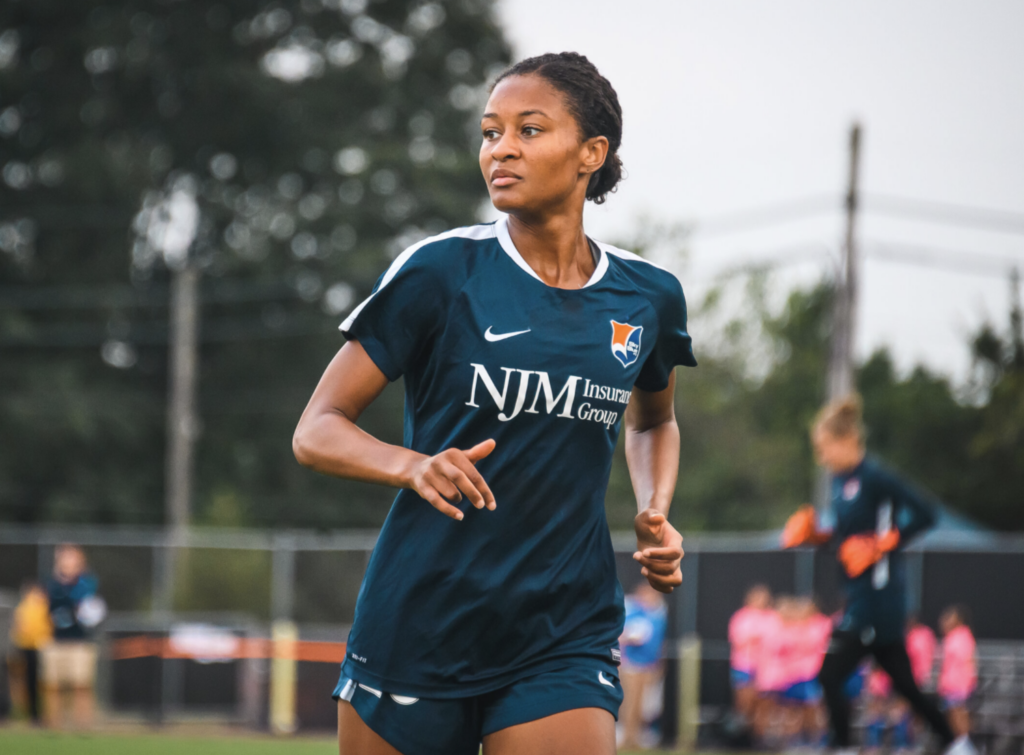
Imani Dorsey is a forward for Sky Blue FC of the NWSL. She spoke with JWS about the NWSL Fall Series, athlete advocacy, and how The Black Players of the NWSL coalition is working to put their social justice messages into action.
Let’s start with the Challenge Cup. How do you think it went and what were your takeaways from living inside of the bubble?
Initially just hearing about the Challenge Cup, it was a bit jarring, especially coming out of quarantine. We went from being only around our roommates for like three months and just training on our own to then heading straight to Utah. And initially, they were like, “You’ll be there for four extra weeks and then four weeks of the tournament.” And that’s a long time to be away from home in this environment, plus testing every week.
It helped once the Player’s Association got involved to make sure we all had a sense of comfort with this “new normal.” The biggest thing for me was the fact that we had the same routine every day. It sort of felt like camp, if you can imagine. I will say, as nice as it was to have my own room and to feel like I had my own space in this situation, there was still a level of discomfort — you were always reminded that this isn’t a normal situation at all, but you’re still expected to perform. Luckily, we had things like our Coffee Angels, who paid for our drinks, and our coaching staff who were all trying to make the environment feel as normal as possible.
Looking back, it’s something that I’ll never forget, for sure. There were definitely highs and lows. Like getting injured before the first game and trying to come back from that was a challenge. On top of that, every player is dealing with the situation of just being a player within this bubble and not wanting to get sick. It’s something that I’m proud of myself for pushing through, and I think everybody feels the same way in that regard.
You hit the nail on the head. Throughout this year, it’s been so difficult to find any clarity or stability. I can’t even imagine the stress you guys went through.
There were just so many ups and downs of “we’re doing this” and “now we’re doing this.” And there’s no sense of stability, so you’re kind of just along for the ride. I will say, all things considered, I am so fortunate and thankful that nobody got sick. It seems like the league did a good job of putting the right protocols in place, and making sure that testing and everything was top of mind. And that’s truly the biggest accomplishment we could’ve asked for.
Now that you’ve played in your first game of this Fall Series and you will be traveling to Chicago for your next, how does this compare to the bubble?
With where we are today, there is always going to be a level of risk in this environment, and it’s basically just doing what you’re comfortable with. The league has made it clear that for this Fall Series, players have the option to opt-out of it if they don’t feel comfortable with the precautions that are being taken.
I think a lot of players still want to play, and still want to use this opportunity to get better. I think these games are great to kind of focus on the little nuances and details of what individual players want to work on. And I think people are happy that we’re just able to have some games, and still be able to train in a team environment.
For the Challenge Cup, I think our team was definitely like, “This isn’t ideal and it is a bit out of our comfort zone, but this is an opportunity for us to have a season.” Before COVID, we were so excited to be playing in Red Bull Arena this year and to have a brand new training facility. We had all of this really good momentum as a club, so we didn’t want that to go to waste. And I think that translated over to the Challenge Cup. We were able to focus on that and focus on our progress. I think the same can be said for the Fall Series, as well. Yes, we have several players that are abroad and our team right now is smaller, but we’re still focusing on the core elements and developing the principles that we feel are important for our team moving forward.
On Sky Blue, you are now reunited with some of your childhood teammates, Midge Purce and Megan Hinz. What has that experience been like for you?
Megan and I played club soccer together a couple of years before high school. She kind of coaxed me, and her mom convinced my parents to encourage me to go to Good Counsel, so then we all ended up there together. Midge was already there. She’s a year above us, so we started playing with her our Freshman year, and then the next year she came and joined our club team. So yeah, we’ve all been together since like 8th or 9th grade. It’s crazy how things come full circle.
I think somebody asked me once if I’d ever think that we’d ever play with or against each other professionally. And in my head, I wasn’t even thinking about playing professionally when we were all in high school. I was just trying to get a college scholarship and see what happens from there. It’s just amazing how the soccer community can be so small and how I’m able to continue to play with some of my closest friends.
Conversations about social justice are more important now than ever. Can you talk a little bit about the importance of using your platform to drive some of these conversations?
This summer, I feel like the tables have turned, just in terms of the larger attention that systemic racism and police brutality is getting in this country. Attention that not only recognizes the horrible, horrific acts that are happening towards Black men and women way more often than people realize in this country, but that also focuses on how people can address their own role in the system and what they can personally do to create change. And that change could be in terms of just whether they harbor prejudiced thoughts, or it could be more substantial ways to fight back against what they see or understand as racism.
In terms of social media, I’m not super active, but when I do share I feel like I want to know that people are listening. And for a long time, I felt like people just didn’t want to hear that from me because in their eyes it’s like, “Oh. It’s just another Black person talking about issues that they feel are affecting them.” I feel like, not that I’ve had to be silent about it, but just that the people who were going to listen were going to listen, and the others just didn’t care or chose not to listen.
But now I feel like it’s crossed this plane where more people are taking ownership and responsibility, and they are really empathizing and trying to understand. People have been reaching out to me and teammates just wanting to understand what our experiences have been like. That’s something new for me, but I think it’s incredibly important. It kind of validates the fact that everybody has a voice and the fact that everyone can share their experience and what they feel passionate about.
A few weeks ago, the Black Players Of The NWSL issued a joint statement condemning systemic racism and demanding justice. Can you talk about this statement, as well as what it’s like being a part of that coalition?
For me, it feels like a breath of fresh air. Like a sigh of relief. I can only speak on my own experiences, but it just brings so much more legitimacy and power knowing that you have the rest of the Black players in this league with you speaking in one unified voice. It’s powerful. You’re just stronger together.
A lot of the reason I love soccer as a sport is just the oneness and togetherness that it takes to win and to succeed and triumph, and working together with your teammates to be better. I think that is exactly the same for social justice.
I find it to be incredibly special that we’ve been able to come together and use this opportunity to explain how we’re feeling in powerful and succinct words. And I think the NWSL community has responded incredibly. People are always asking us what they can do and it seems like everyone is just trying to understand and learn more. I think it’s a great opportunity for people to be like, “Oh, this is what the Black players think. This is how they’re feeling.” It becomes a great platform and resource and it’s just super special to just have the formation of this coalition.
There was also a second statement issued to support the Utah Royals and Tziarra King after the statements made by owner Dell Loy Hansen condemning players for boycotting. Can you talk about that situation from your perspective and also the role that the Black Players of the NWSL can play in helping this league move forward from this?
It was incredibly disheartening to hear the comments that were made. It felt like he was throwing his players under the bus for something that they felt was very important and necessary. It then becomes a very tense and awkward environment. This is your superior, your owner. And it just becomes this weird, uncomfortable power dynamic. So to see that at play was very upsetting.
Any player’s hope is to be in an environment where they are fully supported not only as a player, but most importantly as a person. For DLH to take this very real situation for the black community, and try to turn it around and make it about himself is completely unacceptable. 1/
— Tziarra King (@tziarra) August 27, 2020
I think the statement that we put out speaks for itself, just in terms of that we stand with Z [Tziarra King] and what she had to say, and we’re just incredibly proud of her willingness to speak up in that situation. I think it was important for us to come together to show that we stand with her because we all understand what it feels like to be one of only a few Black players on a team. When you’re a minority in a predominantly white space all the time, issues of race become hyper-focused on you, and sometimes you don’t want that attention. And so, even though you have your own feelings, and you deal with them in your own way, it just becomes too much. So for us to make this united statement, it kind of helps ease the burden of dealing with this situation or feeling responsible for dealing with this situation all on your own.
Z’s comments were so powerful because she didn’t have to say anything and she should not be held responsible for making those comments just because she is a Black person on a team. But just the fact that she was willing to made it even more powerful. She became a voice that I think people needed to hear at that moment.
The great thing about the coalition and us speaking together is the fact that we’re not going to mince our words. We’re not going to beat around the bush. Because in the past, it’s always felt like you had to, just to protect egos or help more people to get on board. But we understand what we want and what we expect moving forward. And that’s why I think this coalition is so important because sometimes you just need a clear voice that’s going to get right to the point and explain exactly how we’re feeling.
Before your last game, the coalition, Sky Blue FC, and the Washington Spirit came together to issue a joint statement and photo that reiterated full support for Black Lives Matter. Can you tell us a bit about how that came together?
I wasn’t directly involved with those conversations, but that’s the great thing about the coalition. The leaders that we’ve elected to be at the head of it are very much involved with the statements that we put out. Everything is approved by every Black player before they are put out, so there’s always an opportunity for input and suggestions.
I think you’ll see in the coming games that each team is looking for different opportunities to continue elevating this platform and bring more awareness and encourage action. I think that’s the important thing moving into this upcoming election.
As we progress over these next few weeks, what are some of your personal expectations and goals in regards to this Fall Series?
For me, it’s all about this platform. It’s not just about soccer. And so while it’s fun to be creative in how we approach these statements, ultimately there are people’s lives on the line. So as we keep moving forward, we’re thinking of ways that would really resonate with people and hit home. We don’t, by any means, want it to detract from the game at hand, but we want people to come away from it being like, “That was important,” in this continuing effort to keep this in the limelight.
You brought up earlier that some of your teammates and peers have reached out to you to help better understand how to be an ally. Through your own experiences, what have you taken away from these conversations and what messages are you trying to better communicate?
I’ve had a variety of conversations. Several are about them not knowing the depth to which these issues are still pervasive throughout society. There are issues of understanding what it means to protest in a game or of using our platforms publicly around like a game, not just on social media, and what that means and why that’s important. There are also a lot of talks about solidarity, in terms of how to be a strong ally. And I think the biggest thing that I take away from these conversations is a willingness to have hard conversations with people around you, that you know may not be as open-minded as you are.
My teammates are incredibly open-minded, compassionate people who I know care about me, and I feel they genuinely do want this problem to be relieved. And if they can help, they want to. Some of my closest friends are in continuous conversations with family and close friends about this upcoming election and what Black Lives Matter truly means, and they’re kind of separating the politicized nature of it from what the real problem is. I think a lot of the conversations that I have with people are separating the politics from the actual issue because you find that people want to hijack a message and make it mean something completely different than what it actually means.
Lastly, I know off-field athlete advocacy is incredibly important to you in general. Can you talk a bit about that and some of your other activist work?
For me, this summer has been incredible, quite honestly, because I feel like so much of what I love about being a pro and advancing in this career is being able to be an advocate and use my platform to make some change happen.
I’ve partnered with Voice in Sport, which launched a couple of weeks ago, because becoming a mentor and somebody that younger players can look up to is something that I’ve always wanted to do. As simple as sharing my experience with them can hopefully teach them something moving forward. I think the biggest thing is knowing that there is this community of women that want to support each other, lift each other up, and bring more visibility to the problems, successes, and triumphs that female athletes face. Which I think is super powerful for Voice in Sport, and very timely in our present moment.
I’m also a part of Athlete Ally. With them, I was so honored that they asked me to be an ambassador last year allowing me to then speak up on issues, especially ones in the transgender community, and try to be a better ally for them. It becomes even more timely right now, in terms of just the emotions that I’ve been through this past couple of months and just how important allyship is and knowing that I value so much when my white teammates come up to me and say, “I stand with you.” You can feel the empathy in their voice, and just them wanting a better world for not just themselves, but for me and my family too.
That, to me, is so powerful. It’s encouraged me, even more, to want to be a louder and stronger ally for the LGBTQ community. It shouldn’t be this way, but for some reason, it’s super important for people who aren’t directly affected by an issue to speak up on it if they feel it is important. Whether it’s a white person speaking up and bringing legitimacy to Black issues that Black players face or me, as a cis straight woman, speaking up on LGBTQ issues. It brings a sense of increased legitimacy that other people are focusing on this issue, other than just the community at hand.
I think the more that we can empathize, look beyond our own circles and circumstances, and understand that others are dealing with different issues we may not be dealing with (or ever encounter) — only then can we work together to build a community that is reliant and trusting upon one another, one which can benefit and provide for everyone.