All Scores

USWNT’s coaching blunders make 2023 World Cup path murkier

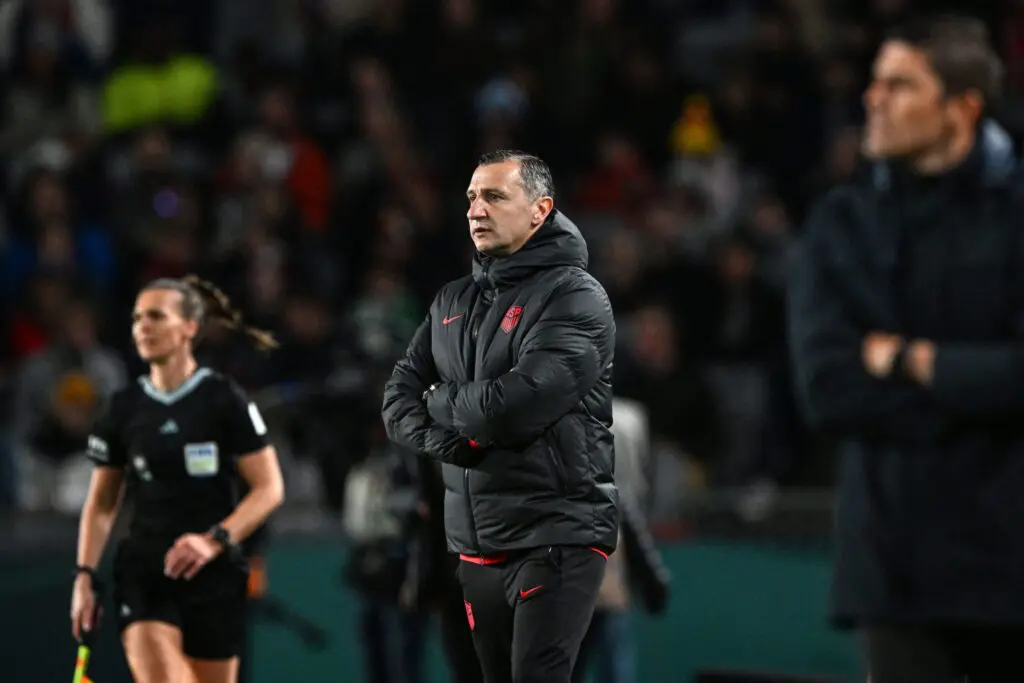
In his first World Cup as USWNT coach, Vlatko Andonovski has overseen the lowest group-stage points total in team history. (Saeed Khan/AFP via Getty Images)

The U.S. women’s national team advanced to the Round of 16 in auspicious fashion on Tuesday, finishing second in Group E following a 0-0 draw with tournament debutantes Portugal. The USWNT made it through the group stage undefeated, but scored only four goals in three games and compiled their lowest World Cup points total in team history after two consecutive draws.

The message after the match from head coach Vlatko Andonvoski and his players was about the importance of surviving and advancing, but the reigning World Champions now have a more difficult path to the World Cup final. They’ll likely face longtime rivals Sweden in their first knockout-round match, with more than a few adjustments needing to be made.

The good news for the U.S. is that they have yet to lose a match while underperforming, but they’re running out of time to fix glaring issues. Here are a few main takeaways from a sloppy, scoreless draw that nonetheless set the stage for the rest of the tournament.

Formational regression hangs players out to dry

No individual players for the USWNT looked sharp against Portugal, but they also were not aided by formational issues that have plagued the U.S. since the start of 2022. Since the Tokyo Olympics, Vlatko Andonovski has been trying to figure out the best combination of formation and personnel to round out the team’s midfield, especially during Julie Ertz’s prolonged absence.

In the middle stages of that key development year, the U.S. tried to slot Andi Sullivan into Ertz’s role in a 4-3-3 formation that prioritized pushing two midfielders forward to aid the attack. Against Concacaf competition in World Cup qualifying, there was logic behind this approach, as the U.S. was tasked with breaking down low-block defenses. Ultimately, the approach worked, even if the USWNT didn’t look like their best selves for much of that tournament.

But the lesson the USWNT should have learned from their tough slate of friendlies against England, Spain and Germany in the latter half of 2022 is that Sullivan needs a defensive partner against similarly balanced midfields. The U.S. adjusted into a 4-2-3-1 formation, with Lindsey Horan and sometimes Rose Lavelle helping occupy defensive space and distribute the ball through the spine of the midfield.

Strangely, in the World Cup group stage, the USWNT lined up in the former setup rather than the latter, despite in-game data showing that two of their opponents were unlikely to sit and wait for the U.S. to attack. The approach might have made some sense against Vietnam, but the Netherlands were clearly coming into the second match with a packed midfield as part of their three-back system. Portugal, likewise, had defensive players step forward to neutralize the U.S. midfield with relative ease.

Scouting abnormalities can be forgiven; it’s the other team’s job to surprise and create problems that the USWNT isn’t anticipating. But Andonovski’s reluctance to adjust to losing the numbers and possession battle in the midfield has placed more strain on individual players than necessary. Against the Netherlands, the U.S. found a second gear to make the system work for them. But against Portugal, the mental fatigue of holding an uneasy shape began to show as players tired.

The shape does not suit Sullivan, who has continued to start in the defensive midfield despite the team’s struggle to move the ball. On Tuesday, the USWNT was relegated to moving the ball in a horseshoe motion from the backline out to the wings, where defensive overloads quickly shifted possession back in Portugal’s favor. Players were so locked into the system that they couldn’t find their open teammates.

Andonovski might be saving a surprise shift to a 4-2-3-1 for the knockout rounds, but more deft adjustments in the group stage might have given the USWNT a better chance at finishing on top. He might also slot Ertz back into the defensive midfield, but with Alana Cook failing to see the field in the team’s first three games, the team’s cohesion is at risk.

img
Lynn Williams started in place of Trinity Rodman against Portugal, but the USWNT still lacked finishing ability. (Robin Alam/USSF/Getty Images)

Continued lack of trust in the bench

After calling for only one substitute against the Netherlands, Andonovski made two changes to his starting XI against Portugal, starting Lynn Williams in the frontline and Lavelle in the midfield. Williams made an immediate impact, but her relative freshness compared to Sophia Smith and Alex Morgan’s fatigue actually added to the lack of cohesion on the frontline, rather than alleviating it.

Lavelle similarly provided a spark but also paid for trying to bring an edge to the midfield, picking up her second yellow card of the tournament that will require her to sit out the USWNT’s Round of 16 match. The rest of the squad appeared to suffer for lack of rest, with both physical and mental fatigue playing a role in the team’s tepid approach to ball progression and chance creation.

When Andonovski compiled this World Cup roster, he had a clear idea of his starters, his depth players and his specialists. After three games, it seems clear his trust mostly lies with his set starters, as those on the bench continue to fight for minutes. Megan Rapinoe made a substitution appearance against Portugal, but her defensive limitations at this stage in her career makes it difficult to start her and relieve some of the pressure on Smith. Sofia Huerta has not gotten much time on the field either, despite being called in to unlock tight, low-scoring games with her service — something the U.S. has struggled with in all three matches.

Instead, Andonovski brought on Emily Sonnett in a 5-4-1 formational shift that saw the U.S. concede more chances in second-half stoppage time than in the rest of the match. He has now locked the USWNT into a process of their own making, with starters who are tiring and substitutes who have not gotten enough World Cup minutes to step in and feel comfortable. It’s the same dilemma that led to Savannah DeMelo getting two quick World Cup starts after just her first cap with the team.

The approach may have been forgiven if the team had gotten all three points against the Netherlands, allowing for heavy rotation in their third match. But in a tournament decided by the finest of margins, the U.S. has now perhaps pushed too hard for results that never came, making the climb ahead of them even steeper.

Claire Watkins is a Staff Writer at Just Women’s Sports. Follow her on Twitter @ScoutRipley.
Final Four Hits the Court in 2025 NCAA Volleyball Tournament

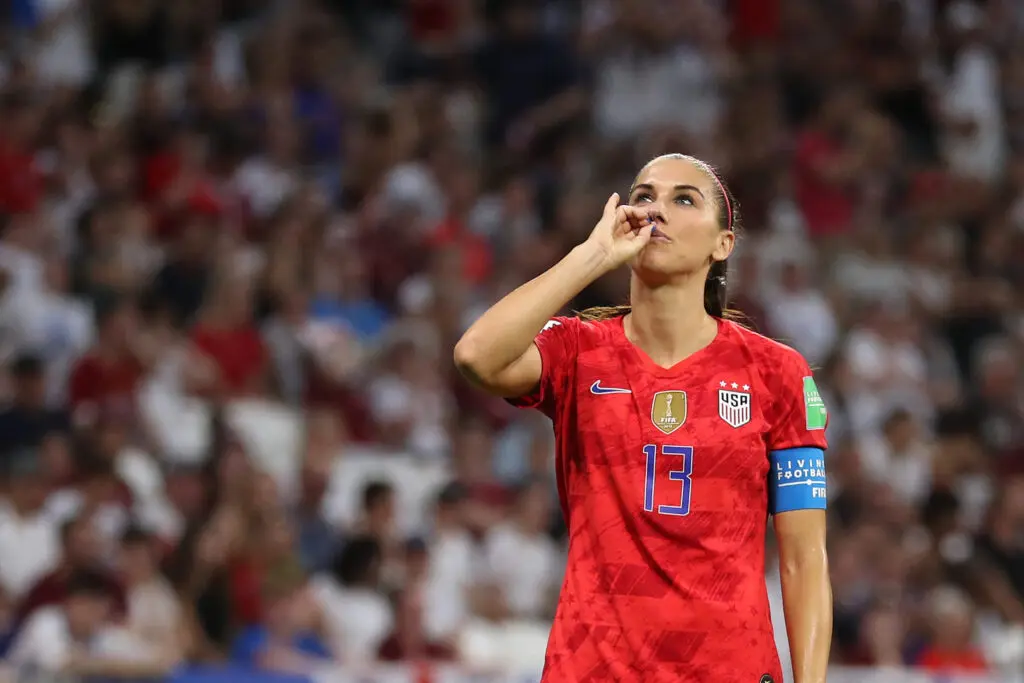
The Kentucky Wildcats celebrate their Elite Eight win during the 2025 NCAA volleyball tournament.
Kentucky is one of two No. 1 seeds to reach the 2025 NCAA volleyball tournament's Final Four. (Arden Barnes-Imagn Images)

The 2025 NCAA volleyball season is down to four top teams, as the Division I national championship tournament's Final Four takes the court in Kansas City on Thursday night.

No. 1 seeds Pitt and Kentucky survived a series of high-profile tournament upsets to punch their tickets to Thursday's semifinals, where No. 3 seeds Texas A&M and Wisconsin will join the Panthers and Wildcats.

"The Final Four is just so special, it is so incredible," Wisconsin head coach Kelly Sheffield said ahead of Thursday's action. "You want as many of your players that are committed, that decide to come here, you want them to experience that."

Two teams will look to make history this weekend, with Pitt and Texas A&M both in pursuit of a program-first national championship.

While the Aggies are in uncharted territory, booking their first-ever semifinals berth last weekend, the Panthers are hunting a breakthrough, hoping to claim a first-ever championship final appearance in their fifth consecutive trip to the Final Four.

As for Kentucky and Wisconsin, the Wildcats and Badgers will be looking to add a second trophy to their cases after booking their first program titles in 2020 and 2021, respectively.

How to watch the 2025 NCAA volleyball Final Four

The 2025 NCAA volleyball semifinals begin at 6:30 PM ET on Thursday, when No. 3 Texas A&M takes on No. 1 Pitt before No. 3 Wisconsin faces No. 1 Kentucky at 9 PM ET.

Both Final Four clashes will air live on ESPN.

FIFA Sets Women’s Soccer Allocations for 2028 LA Olympics

The USWNT stand on the podium wearing their gold medals at the 2024 Paris Olympics.
The reigning Olympic champions USWNT will get an automatic berth into the 2028 LA Games as hosts. (Brad Smith/ISI/Getty Images)

As the 2028 LA Olympics come into focus, the FIFA Council unveiled the regional allocations for the Summer Games' first-ever 16-team women's soccer tournament this week.

According to the Council's Wednesday report, 2.5 slots will go to AFC (Asia), 2 to CAF (Africa), 3 to Concacaf (North and Central America), 2.5 to Conmebol (South America), 1 to OFC (Oceania), and 4 to UEFA (Europe), with one additional slot reserved, as always, for the host nation — the reigning Olympic gold medalist USWNT.

While the expanded competition allows for greater depth, one AFC and one Conmebol team will ostensibly have to face an inter-continental playoff to determine which region can send an additional team to the 2028 Olympics.

One the other hand, Concacaf's representation will double from 2024, growing from two to four teams given the automatic berth of the USWNT.

Similarly, after host nation France's autobid boosted UEFA'a 2024 allocation to three teams, this week's new distribution doubles the European confederation's previous non-host two-team max for the LA Games — meaning all four of the 2027 UEFA Nations League semifinalists will qualify to compete for gold in 2028.

Notably, CAF and OFC are the only confederations to not see an increase on their previous allocation from the FIFA Council.

2025/26 PWHL Takeover Tour Hits the Road in Front of Sold-Out Crowd

The Toronto Sceptres and Montréal Victoire await the puck drop at the first 2025/26 PWHL Takeover Tour stop in Halifax, Nova Scotia.
Montréal defeated Toronto with a 2-1 shootout out win in Halifax to kick off the 2025/26 PWHL Takeover Tour. (PWHL)

The puck dropped on the 2025/26 PWHL Takeover Tour on Wednesday, when the No. 2 Montréal Victoire took down the No. 5 Toronto Sceptres 2-1 in an overtime shootout in front of a sold-out crowd in Halifax, Nova Scotia.

Packed into Scotiabank Centre, 10,438 fans watched Team Canada and Victoire captain Marie-Philip Poulin score the shootout's lone goal, handing Montréal their third straight win.

"It was amazing to see the young girls and boys in the crowd wearing our jerseys, saying our names, and wanting our autographs," said Victoire head coach Kori Cheverie. "It's just extremely special."

The PWHL's 16-stop Takeover Tour is just beginning, with nine games planned for Chicago, Dallas, Detroit, Washington DC, Denver, and more before the league pauses for the 2026 Winter Olympics.

"We hope that the impact is a positive one. Everywhere we go, that's the impression we want to leave — for little girls to know that they have a dream and that their dream can become a reality," said Sceptres captain and Nova Scotia product Blayre Turnbull following Wednesday's Tour stop.

Halifax marks the third-year league's fourth sold-out stop, joining fellow Canadian cities Edmonton, Québec City, and Vancouver.

How to attend the 2025/26 PWHL Takeover Tour

The PWHL will next pull into Chicago's Allstate Arena for a Takeover Tour stop on Sunday, when the No. 8 Ottawa Charge will take on the No. 6 Minnesota Frost on at 2 PM ET.

Tickets are currently available for purchase via Ticketmaster.

Napheesa Collier Says “Nothing Has Changed” Amid WNBA CBA Negotiations

Minnesota Lynx star Napheesa Collier speaks to media after a 2025 WNBA game.
Minnesota Lynx star Napheesa Collier remains confident in the WNBA Players Association amid strained CBA talks. (Steven Garcia/Getty Images)

Months after Napheesa Collier set the WNBA ablaze with her viral exit interview criticizing league leadership, the Minnesota Lynx star said "nothing has changed" at the front office level as CBA negotiations stall.

"The conversation has been had now [and] people are seeing that changes need to be made," Collier said this week from Miami, where Unrivaled 3×3 is gearing up for its second campaign.

"I feel confident in the [union] and where we are internally with our players and the future," she continued.

In her October press conference, Collier publicly called the WNBA front office "the worst leadership in the world," putting commissioner Cathy Engelbert in the hot seat amid tense CBA negotiations with serious implications on next season's play.

The league and the WNBPA are currently sparring over revenue sharing, with diverging compensation expectations further distancing the two sides.

"Obviously, there's frustration in that both sides are trying to get what they want, but we still have that fire within us that we're willing to do what it takes," Collier said. "We're going to do whatever it takes to get what we think we deserve."

As talks drag on, Collier sees Unrivaled — the offseason 3×3 league she co-founded with New York Liberty star Breanna Stewart — as fueling the players' fight.

"Us being here in December and January until March, it's a crucial time in the CBA," Collier acknowledged.

"Having us all in one place is beneficial," she explained. "To have players congregate in that way, where you can have those in-person conversations and updates like that, that does help to get things moving more quickly."