Angel City center back and captain Sarah Gorden and goalkeeper Angelina Anderson spoke out on Thursday, opening their gameday press conference by addressing Monday's New York Post op-ed penned by teammate Elizabeth Eddy that urged the NWSL to adopt a "clear standard" for gender eligibility.
"Questions and controversy abound over intersex and transgender athletes," Eddy wrote, suggesting the league require players be "born with ovaries" or undergo genetic testing, with a photo of Orlando Pride and Zambia striker Barbra Banda — who faced fan harassment earlier this year — as the lead image.
The article — and its originating tweet — provoked backlash online, with Angel City issuing a statement on Tuesday saying the op-ed "does not reflect the opinion of an entire organization," and that the team "has remained committed to equity, inclusion, and belonging."
ACFC captain Gorden used stronger language, saying that the article directly caused her teammates "hurt" and "harm."
"We don't agree with the things written for a plethora of reasons, but mostly the undertones come across as transphobic and racist," Gorden, who has a history of addressing social justice issues, told reporters.
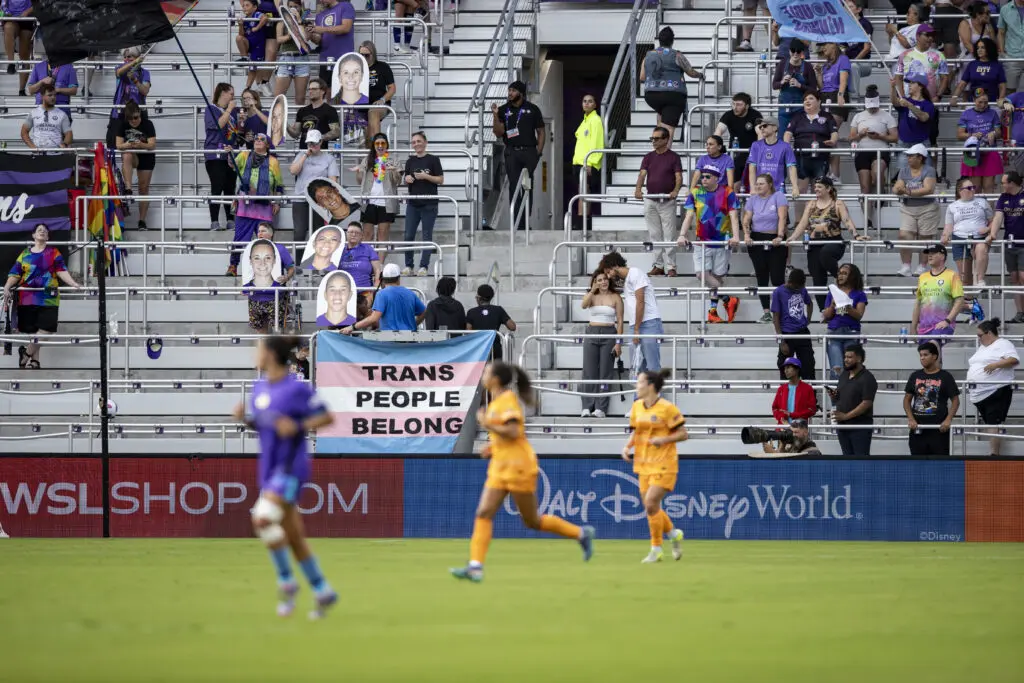
Gender policy abandonment "invites harassment" of NWSL players
After quietly abandoning a 2021 policy that deemed all transwomen eligible so long as their testosterone levels mirrored those assigned female at birth, the NWSL has failed to provide official gender eligibility guidelines in the three years since — though no current league athletes identify as trans.
"The league may have hoped its silence over this lack of policy would be taken as an openness to revisiting or reworking its approach, or at least neutrality when it comes to the inclusion of trans and intersex players," wrote The Athletic’s Meg Linehan in response.
"But the league and commissioner Jessica Berman's silence have instead repeatedly invited harassment of current players — to whom such a policy would not apply in any case — especially Black and queer players."
According to an NWSL Players Association spokesperson, collective bargaining — rather than the league itself — must determine all policy matters, including guidelines surrounding gender eligibility.
As for where the players union stands on the issue, the spokesperson told The Athletic that "Any position the NWSLPA takes…is and will be the product of a thoughtful, deliberate process that engages all our members and the issues that are important to them."
Elizabeth Eddy is a midfielder currently playing for Vittsjö GIK in Sweden on loan from Sky Blue FC of the NWSL. She spoke with Just Women’s Sports about her experience in the Challenge Cup, arranging a loan to Sweden, and the differences between the two countries’ responses to the coronavirus pandemic.
Before you were loaned to Vittsjö GIK in Sweden, you played with Sky Blue in the Challenge Cup. What was that experience like for you? How was living in the bubble and playing without fans?
Our understanding as athletes is that the goal is to play the sport, and we are willing to do whatever is necessary. And with coronavirus and how governments handled things, how the world handled things, we were forced to play in a bubble. And so it was to some degree a glorified jail, but I would say they made it a very enjoyable jail.
We enjoyed it as much as you can. You’re always in a group, and it was very scheduled, to the point where it’s like, here’s your breakfast slot, here’s your training slot. You’re like, “Oh, I have no free choice ever,” which I personally do not like but I’m aware that that’s the choice. If you want to play in this world with coronavirus, you have to be okay with giving up some freedom. I’m aware of the cost, and I’m willing to pay it, but I also am not a big fan of it.
But like I said, all things considered our leaders did a fantastic job of making it as enjoyable as possible, as professional as possible. And they did a very, very good job, so it was really fun. We had a game room where it was ping pong all the time. We had snack rooms. I will say the one huge blessing out of the whole thing is that you end up getting really close to some of your teammates because you live on the same floor of a hotel for however long you’re in the bubble. So you get to become really good friends and spend a lot of time together and getting social. I think that was a really cool portion of it.
You arrived in Sweden a week ago to play on loan through the fall. During the loan process, what was the communication like from the league and how did the opportunity come about?
Before the bubble tournament started, one of my prior teammates from when I was at home texted me and was like “Hey, Liz, would you want to play in Sweden potentially? We need somebody that can play the position that you play.” I was like, “Yeah, what’s the information?”
So she sent me her coach’s contact information and that’s how I found one of the coaches who is Swedish. The cool thing about Sweden, which I didn’t know, is that every single person in Sweden speaks English and they start at around age seven. So I talked with the coach and he was great. He told me: “I care a lot about the character of our players. And because Sabrina, who’s already with this team, vouches for you, that carries a lot of weight because the culture of the team is really important,” which I thought was really cool, because when you’re on a team where the culture is very good, people respect each other and they love each other and they have a lot of fun together. It’s just a really healthy environment that gives your team much higher chance of success.
So it ended up working out. The loan agreement stuff from the NWSL side was, I would say, pretty difficult. And I think the big reason why was because they were in the middle of the Challenge Cup and trying to rush that. But I had reached out to our GM, and we have a good relationship. I think I messaged her for like a month, probably every single day asking her what the next step was and what I needed to do. I told her that I negotiated with the Sweden team to get the contract all set up. Like, “Here it is. What else do you need from me?” And honestly I was hoping and praying it would work out because I wanted to continue to play. And you only get better at something by being able to practice, constantly practice. I’m super thankful to be here.
How has everything been with the virus there? I am assuming it is very different from the US.
Not a lot of people are wearing masks here. It seems like everything’s fine. I know that the virus is real, but how they handle it, it’s been very healthy in the sense of not being paranoid and really out of control. And I think also just the size of the country, and how the rest of the world tries to go to America all the time, and so you see a lot of opportunities for people to bring the virus. I think in Sweden there’s just less people coming through. So I think that is how they are allowed to have the freedom to choose to handle this one. But most of the people I asked them, I was like, “How did you guys handle it?” They’re like, “Well, when the government says to do something, most people just do it.” They don’t complain. They’re just like, “Oh, we trust our government,” where I’d say that’s a difference with America, where it’s harder to trust the leadership.
Are there any protocols while playing?
Well they didn’t have any fans at games for a while and I think the week before I got here was the first time they’ve had fans, and they capped at 50. They had 50 fans in the stands, and they’re really cool supporters, just hyped about the game. The town I am in is 1,800 people, so everybody knows you when you walk around.
This was obviously a crazy year. Assuming next year is different, what are your soccer goals for 2021?
My goals moving forward are to become the best soccer player I can, and one day to play for the USWNT. That’d be my biggest goal, and that’s what I’m aiming for. That’s the big reason I come here to play in games and continue to develop as a player.