The FIFA Council codified its gender equity push this week, passing legislation on Thursday that requires every women's soccer team participating in a FIFA-sanctioned event to feature a woman head coach or assistant coach on its staff.
Additionally, all women's teams must staff a minimum of three women — including one specifically on the medical staff — with the aforementioned assistant or head coach counting toward the global governing body's newly required tally.
The new rule comes into effect prior to this year's U17 and U20 Women's World Cups, with all of FIFA's youth and senior women's national team tournaments and club competitions subject to the new mandate.
"There are simply not enough women in coaching today," FIFA chief football officer Jill Ellis said in a Thursday statement. "We must do more to accelerate change by creating clearer pathways, expanding opportunities, and increasing the visibility for women on our sidelines."
Though top sideline leaders like USWNT manager Emma Hayes and England boss Sarina Weigman populate headlines alongside their team's trophies, the vast majority of women's football coaches are still men.
Citing the fact that just 12 of the 32 head coaches at the 2023 World Cup were women, Thursday's FIFA statement explained that the governing body is seeking to match "the rapid growth of the women's game" with "an increased representation of women in technical and leadership roles."
Along with the implementation of this week's rule, FIFA's strategy to bolster the ranks of women on the sport's sidelines includes coaching eduction programs and directly supporting other professional development initiatives.
"The new FIFA regulations, combined with targeted development programs, mark an important investment in both the current and future generation of female coaches," added Ellis.
As the 2028 LA Olympics come into focus, the FIFA Council unveiled the regional allocations for the Summer Games' first-ever 16-team women's soccer tournament this week.
According to the Council's Wednesday report, 2.5 slots will go to AFC (Asia), 2 to CAF (Africa), 3 to Concacaf (North and Central America), 2.5 to Conmebol (South America), 1 to OFC (Oceania), and 4 to UEFA (Europe), with one additional slot reserved, as always, for the host nation — the reigning Olympic gold medalist USWNT.
While the expanded competition allows for greater depth, one AFC and one Conmebol team will ostensibly have to face an inter-continental playoff to determine which region can send an additional team to the 2028 Olympics.
One the other hand, Concacaf's representation will double from 2024, growing from two to four teams given the automatic berth of the USWNT.
Similarly, after host nation France's autobid boosted UEFA'a 2024 allocation to three teams, this week's new distribution doubles the European confederation's previous non-host two-team max for the LA Games — meaning all four of the 2027 UEFA Nations League semifinalists will qualify to compete for gold in 2028.
Notably, CAF and OFC are the only confederations to not see an increase on their previous allocation from the FIFA Council.
The 2031 Women's World Cup will expand to 48 teams, with the 16-team increase announced among other landmark decisions by the FIFA Council on Friday.
The decision to expand the World Cup aims to "broaden representation, offering more nations and players access to elite competition and accelerating investment in women's football worldwide," according to the FIFA release.
"The FIFA Women's World Cup 2023, the first in which teams from all confederations won at least one game and teams from five confederations reached the knockout stage, among many other records, set a new standard for global competitiveness," said FIFA President Gianni Infantino.
"This decision ensures we are maintaining the momentum in terms of growing women’s football globally."
The expanded 2031 World Cup, hosted by the US, will adopt a 12-group format, increasing the total number of matches from 64 to 104 while extending the competition for an additional week.
The World Cup expansion announcement comes on the heels of last month's increased Olympic tournament news, with the IOC boosting the women's soccer field to 16 teams at the 2028 LA Games.
The decision also puts the women's competition in line with the men's World Cup, which will feature FIFA's first 48-team tournament in 2026.
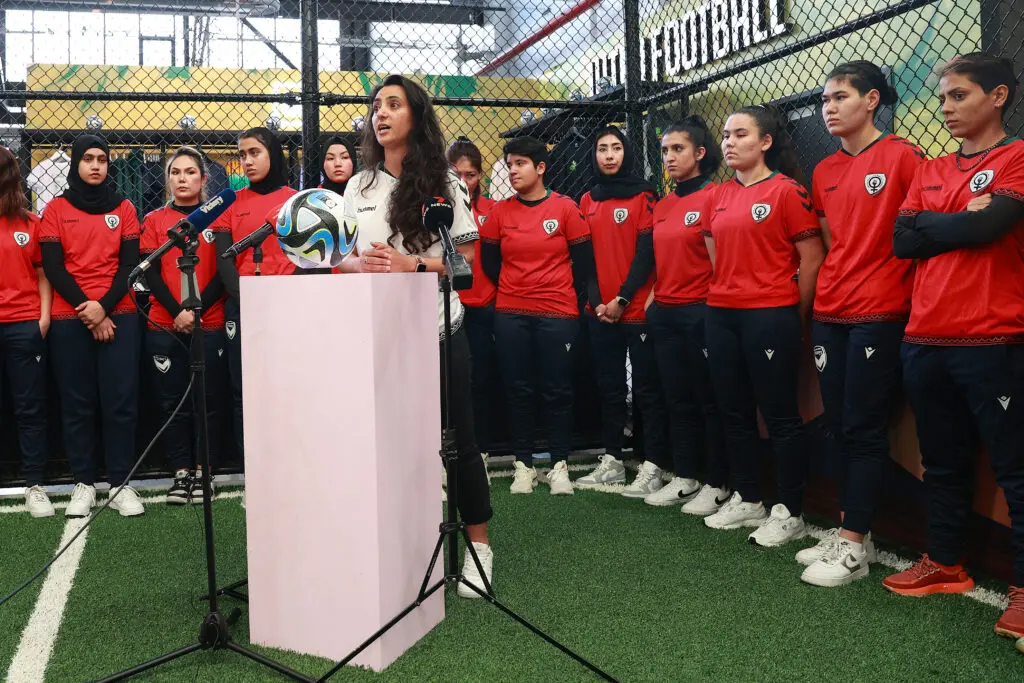
FIFA approves Afghan women's refugee team
In the same Friday announcement, the FIFA Council also approved the creation of an Afghanistan women's refugee team, which would provide evacuated Afghan women players the ability to compete on an officially recognized FIFA team.
While FIFA requires that national federations sponsor teams, the Afghan Football Federation ceased acknowledging its women's team once the Taliban-controlled government banned women's sports.
Originally formed by the country's Olympic Committee in 2007, the Afghanistan women's national team has not played a FIFA-recognized match since 2018, and most of its athletes fled the country amidst the Taliban's second takeover in 2021.
Since then, players have petitioned FIFA for the opportunity to compete. Their efforts earned a one-year trial phase from the governing body on Friday, though the success of the program could see it expanded to refugees from other nations in the future.
"We are happy that FIFA has created a pathway for Afghan players to finally return to the field," team founder and former captain Khalida Popal told CNN on Friday, adding that the squad "remain[s] hopeful FIFA can amend its statutes to provide official recognition for our players as the Afghanistan Women's National Team."
Popal — who helped hundreds of Afghans, including the team, escape the Taliban — previously said the team "could show the world that Afghan women and girls belong in sport, in school and everywhere in society — and we will not be defeated."
The USWNT held fast to the world No. 1 spot in Thursday’s updated FIFA rankings, dropping 18 points since their 2024 Olympic gold medal-winning run but still sitting 49 points ahead of No. 2 Spain.
Also maintaining their elite rankings were No. 3 Germany and No. 4 England, who each trail their predecessor by a mere six points.
Japan earned the Top 10's biggest boost, fueled by a 2025 SheBelieves Cup championship run that included a rare defeat of the US. As a result, the Nadeshiko leapt from No. 8 to No. 5, overtaking No. 6 Sweden, No. 7 Canada, and No. 8 Brazil in the process.
Japan's jump made them the only team in FIFA's Top 75 to rise more than two spots.
US Soccer officially intends to bid on 2031 World Cup
While the world No. 1 USWNT doesn't have any major tournaments to build toward this year, US Soccer is cementing future plans to bring the sport's biggest competition back to the US.
The national federation formally confirmed its intent to submit a bid to host the 2031 World Cup on Wednesday evening, bolstered by FIFA’s motion earlier that day which dictates that the 2031 tournament must be played either in North America or Africa.
"We are excited by the opportunity to welcome teams and fans, inspire the next generation, and grow the game regionally and globally," US Soccer announced on social media.
Though a formal bid submission is still to come, the US is already a frontrunner for hosting the competition. FIFA will decide on the 2031 World Cup host nation at the governing body's 76th Congress in 2026.
FIFA's other main decision-making group, the FIFA Council, could soon see incumbent US Soccer president Cindy Parlow Cone join its 37-member ranks, as the former USWNT star is currently running unopposed for the North American seat previously held by ex-Mexico Football Federation president Yon de Luisa.
The US hasn’t held a FIFA Council seat since ex-USSF president Sunil Gulati’s position expired in 2021.
Cone’s likely March 15th election — plus the USWNT’s No. 1 ranking and planned 2031 World Cup hosting bid — gives US Soccer a valuable foothold in the global game.