US track star Allyson Felix is getting more specific about what her Olympics return might look like.
After announcing plans to come out of retirement and pursue a spot at the 2028 Los Angeles Games, Felix says her ideal path back would likely center around Team USA's relay pool rather than an individual event.
“My ideal situation would be to try to make the relay pool for maybe the mixed 4x400m relay,” Felix said Thursday on TODAY. “It’s a tall task to get back to that level, but I’m excited to really push for it.”
After retiring in 2022, Felix announced last month that she plans to resume full training in October with longtime coach Bobby Kersee as she prepares for what could be her sixth Summer Games.
The 2028 Olympics hold special significance for Felix, as they'll take place in her hometown of Los Angeles.
“If it wasn’t LA, I wouldn’t be as curious,” she said. “I just can’t imagine not going for it with it being in my hometown.”
Felix won 11 medals across five Olympics — including seven golds — making her one of history's most decorated track and field athletes.
If she qualifies for LA28 at age 42, she would become the first US track and field athlete to reach six Olympics.
However, the comeback won't be easy.
To make the relay pool, Felix would likely need a strong US Olympic trials showing, where spots traditionally go to athletes who reach the 400-meter final. USATF has not yet announced official qualification procedures for the 2028 Games.
Still, the track icon says she's at peace with the challenge ahead.
“There’s nothing to prove,” she added. “It’s just about testing the limits... Either way, I think it’s just about the success of courage, of going for it.”
USA Basketball learned its path toward a fifth consecutive world title on Tuesday, as FIBA announced the group stage draw for the 2026 Women's World Cup in Berlin.
Team USA landed in Group D alongside China, Italy, and Czechia. Held every four year, the 2026 tournament marks the first FIBA World Cup with an expanded 16-team field, with the previous format featuring just 12 teams.
USA Basketball enters with dominant head-to-head records against all three group opponents. The US is 8-0 against China in World Cup competition while stand 2-0 against Czechia.
Italy presents Team USA's only competitive loss. The pair's head-to-head record is split 1-1, though they haven't faced each in World Cup play since 1979 —, when the US won 66-64.
Duke coach Kara Lawson leads USA Basketball as head coach. Managing director Sue Bird will oversee the 12-player roster selection.
The tournament features host Germany in Group A alongside Japan, Spain and Mali. Group B includes France, Hungary, South Korea, and Nigeria. Group C showcases reigning European champion Belgium alongside Australia, Puerto Rico, and Turkey.
The WNBA is planning a three-week regular-season break to accommodate top US and international players competing at the FIBA World Cup.
How to Watch USA Basketball at the 2026 FIBA World Cup
The FIBA World Cup tips off September 4th in Berlin, Germany, when USA Basketball opens group play against China. The game is a rematch of the 2022 FIBA World Cup Final, after the US dominated that title game 83-61.
Group-stage winners advance directly to the quarterfinals on September 10th, while second- and third-place finishers compete for the remaining four quarterfinal berths on September 8th and 9th.
The semifinals take place September 12th, with the championship game following on September 13th.
Laila Edwards is preparing for the next step in her women’s ice hockey career, confirming that she’ll enter the PWHL draft after graduating from Wisconsin this year.
Edwards, a three-time NCAA champion with the Badgers, will graduate on May 9th with a 4.0 GPA and a degree in social welfare. As she recently told Good Morning America, going pro is now the plan, with the PWHL draft set for late June.
“Pro? That’s the plan,” Edwards said. “Entering the draft at the end of June.”
The forward has played a key role in the Badgers’ recent success, while also helping Team USA win gold at the 2026 Winter Olympics.
The 22-year-old made history in Milan, when she became Team USA’s first Black woman goal-scorer in February’s 5-0 group-stage win over Canada. Opening up about her experience, Edwards pointed to the impact she hopes to have — both on and off the ice.
“I think representation matters, so to be that representation means the world,” she said. “That is the greatest reward, by far… the inspiration. It’s everything.”
Edwards also emphasized how she wants to be remembered as her career continues to develop.
“I’m super competitive. I love winning,” she said. “But I want to leave a legacy about who I was as a role model, a leader, and a person.”
Edwards is expected to be one of the top players to watch in the 2026 PWHL Draft — alongside fellow USA Hockey and Wisconsin teammate Caroline Harvey.
She also added that her long-term plans extend beyond hockey, pointing to a future focused on helping others.
“Whatever I’m going to do with that, I don’t know yet,” Edwards said of her Bachelor’s degree. “Just the idea of helping people who need help.”
Oksana Masters made history again on Saturday, as the multi-sport talent earned gold in the women's sprint sitting Para biathlon to pad her already dominant resume as Team USA's most decorated Paralympian.
Masters' Saturday championship is also the first gold medal for the US at the 2026 Winter Paralympics.
"My emotions are just pure shock, I did not expect this," said Masters following her win. "All I was hoping was just to have a good time in the shooting range. I did not expect a podium finish to be honest, let alone a gold."
With 10 Paralympic victories — six Winter Games golds and four Summer golds — Masters now boasts an astounding 20 medals, earning podium finishes in rowing, cycling, cross-country skiing, and biathlon across seven different Paralympic Games.
Appearing in every Paralympics since 2012, the 36-year-old is coming off a difficult run, needing surgery over the summer as well as suffering both an infection and a concussion in the weeks leading up to Milan.
"I'm starting to realize that's who I am," she said. "I have to have adversity going into the Games, although I don't like it."
No stranger to conquering challenges, Masters leans on her "very strong 'why'" to outlast the competition.
"It's for every Paralympian, every athlete with a disability that was overlooked and was told they were never going to be enough and didn't belong," she explained after her Saturday victory. "That helps me overcome those adversities."
How to Watch Oksana Masters at the 2026 Winter Paralympics
Masters will next compete in Tuesday's para cross-country skiing competition, with qualifying beginning at 4:45 AM ET before the medal race starts at 8:22 AM ET.
All rounds will stream live on NBCOlympics.com.
The International Paralympic Committee announced record women's participation at the 2026 Winter Paralympics in Milan Cortina, with 160 women's sports athletes competing across six sports.
The milestone marks the fourth consecutive Winter Games to feature a record number of women's sports athletes.
Women's participation increased by 24 athletes compared to the Beijing 2022 Games. The growth demonstrates expanding opportunities for women's Paralympians throughout winter sports.
"That's fantastic," US wheelchair curler Laura Dwyer said of the record. "As a female, as a mom, as someone injured, it feels amazing to be a part of that, to show the way for others."
Dwyer became paralyzed from the waist down in 2012, after a 1,000-pound tree branch fell on her while on the job as a landscaper. She now competes for Team USA in wheelchair curling.
Five sports are seeing record women's participation this year. Para alpine skiing leads with 57 women's competitors, followed by para cross-country skiing with 65, para biathlon with 45, wheelchair curling with 25, and para snowboard with 15.
Para ice hockey will feature a female athlete for the second consecutive Games and fourth time overall since the sport joined the Paralympic program. The sport remains mixed-gender despite excluding a separate women's competition.
The 2026 Winter Paralympics opened Friday with a ceremony in Verona, Italy, as 616 total athletes from 56 nations compete for 79 medal events through March 15th.
The competition coincides with the Winter Paralympics' 50th anniversary, after the inaugural 1976 Games featured fewer than 200 athletes from 18 countries competing in just two sports.
US skier Lindsey Vonn faced a possible left leg amputation after a devastating crash in the downhill event at the 2026 Winter Olympics, the decorated star said in a social media video on Monday.
In addition to a broken right ankle and left fibula fracture, Vonn suffered an extremely complex left tibia fracture after clipping a gate mere seconds into her downhill run on February 8th — just days after tearing her left ACL in the leadup to Olympic competition.
In the aftermath of the trauma, the 41-year-old experienced compartment syndrome, a complication in which bleeding or swelling cause significant pressure that, in serious cases, can lead to nerve damage, muscle damage, and even limb loss — necessitating a procedure called a fasciotomy.
Vonn actually credits her torn ACL with saving her leg, as the previous injury was the reason that Team USA orthopedic surgeon Dr. Tom Hackett, who performed the emergency fasciotomy, traveled to Italy with the skier.
"If I hadn't [torn my ACL,] Tom wouldn't have been there. He wouldn't have been able to save my leg," Vonn said. "I feel very lucky and grateful for him."
Following multiple surgeries in both Italy and the US, Vonn is out of the hospital but wheelchair-bound, as the five-time Olympian faces an extended rehabilitation and recovery period that will likely take longer than a year.
"It has been quite the journey and by far the most extreme and painful and challenging injury I've ever faced in my entire life times 100," Vonn explained. "It's going to be a long road."
That said, Vonn has "no regrets" about her fight to return to the Olympic stage.
"I wish it had ended differently, but I'd rather go down swinging than not try at all," she said. "This year was incredible and so worth everything."
Now that the final anthem of the 2026 Games has sounded, Team USA has officially shattered the women's Winter Olympics medal count record with 17 total medals across all sports — excluding mixed events.
Six of those 17 were golds — from alpine skier Breezy Johnson's downhill win and bobsled legend Elana Meyers Taylor's first-ever Olympic gold to the US women topping the hockey podium — adding another high-mark to the list as the USA collectively took home a program-record 12 gold medals in 2026.
"Our team is so strong," said slalom champion Mikaela Shiffrin. "Everybody just showed up with so much courage and heart here. I'm so proud to be part of this American team."
Counting individual, team, and mixed events, more than 40 US women's sports athletes are leaving the Games with at least one medal — another Winter Olympics record for Team USA.
Along with mixed events, USA women helped earn 21 of the team's 33 medals in Milan, with their medal count including eight of the team's 12 golds and all but one of the nine 2026 bronzes.
"You still have to look back and point to Title IX and the effects of the ability to have those competitive years in an elite collegiate system that helps drive the success for women in ways that other countries just haven't yet benefited," explained US Olympic and Paralympic CEO Sarah Hirshland.
US women's curling has eyes on the prize, with Team USA surviving a four-team race for the final two Olympic semifinal spots by defeating Switzerland in a 7-6 thriller on Thursday.
Kicking off the matchup tied for third on a 5-3 round-robin record with Canada and South Korea — with defending champion Great Britain's semifinal hopes trailing just behind on a 4-4 tally — the USA's most direct path to this weekend's Olympic medal rounds required a win over the already-qualified Swiss squad.
Led by newly crowned mixed doubles silver medalist Cory Thiesse, the US entered Thursday's win-and-in game coming off a stinging 8-7 loss to Great Britain — a contest that would have clinched their semis spot had the USA claimed victory.
"That one hurt a little more," captain Tabitha Peterson said postgame. "I think maybe I just attacked wrong on my second-to-last shot, and then I just didn't make my last one either. That's unfortunate, but they made a fantastic shot, so not much you could do about that."
Peterson flipped the script on Thursday, however, coming in clutch after Switzerland forced an extra frame with a stunning 10th-end three-stone tally to tie the US 6-6.
The 36-year-old skipper then broke the deadlock with her final shot to secure both the win and the USA women's second-ever trip to the Olympic semifinals — the team's first medal round berth in 24 years.
The Stateside quartet will now take aim at a first-ever podium finish alongside Canada, who secured the final spot in the knockouts by defeating South Korea 10-7 on Thursday, Switzerland, and the top-seeded three-time champion Sweden.
How to watch US women's curling in the 2026 Olympic semifinals
At the same time that Canada faces Sweden — arguably the toughest team in the field — Team USA will look to hand Switzerland a second straight loss when the pair meet again less than 24 hours after Thursday's result.
Both semifinals begin at 8:05 AM ET on Friday, airing live on Peacock and USA Network.
As one of the most successful nations in Olympic figure skating history, Team USA's women's figure skaters continue to make a lasting impact on the sport across all levels of competition. Starting in the 1950s, the US has produced seven women's singles Olympic gold medalists — and several athletes who shaped the sport without ever winning gold.
From mid-century pioneers like Tenley Albright to Gen Z heroes like Amber Glenn, these are the 10 most important Olympic women's figure skaters in Team USA history.
Team USA's Top Women's Figure Skaters
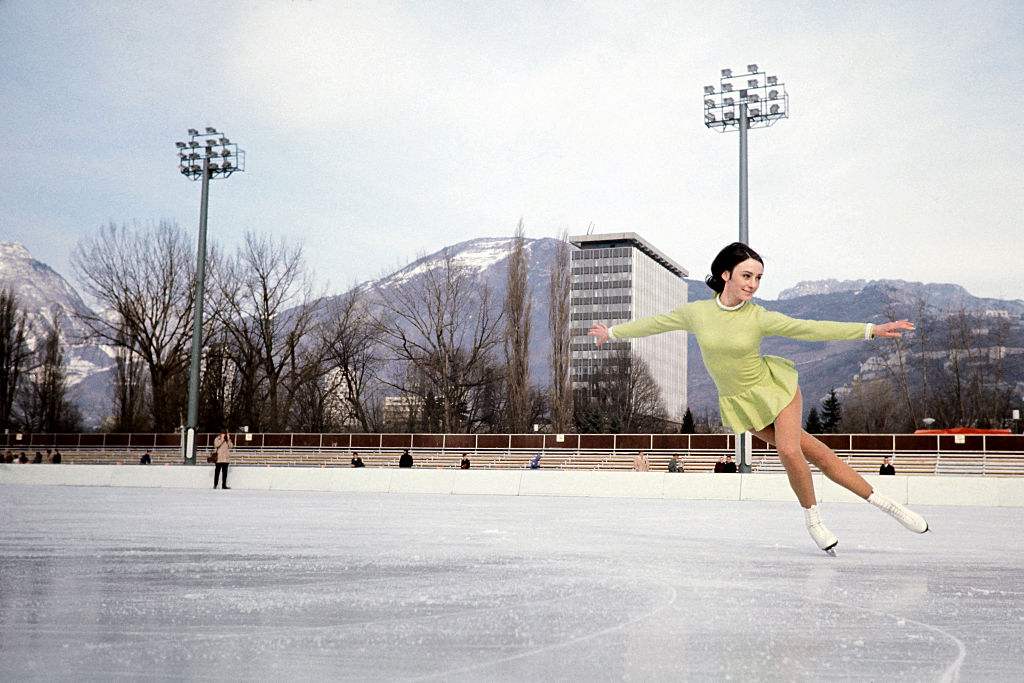
Tenley Albright
Tenley Albright contracted polio at age 11, subsequently defying the odds by winning Olympic silver at the 1952 Oslo Games. Four years later in Cortina, she sliced her ankle to the bone in practice days before competition but skated through the injury, becoming the first US women's figure skater to win Olympic gold. Albright also captured figure skating's first-ever triple crown, winning the World, North American, and United States ladies titles in a single year.
Going on to become the first woman to serve as a United States Olympic Committee officer, Dr. Albright was later named one of Sports Illustrated's 100 Greatest Female Athletes.
Carol Heiss
At just 15, Carol Heiss placed second behind trailblazer Tenley Albright at the 1955 World Championships. However, she went on to flip the script, taking the Worlds title from 1956 until 1960.
She similarly won silver behind Albright at the 1956 Cortina Games, before returning to win gold at the 1960 Squaw Valley Games. Though she retired shortly after winning gold, Heiss's international run of dominance cemented her as one of the most consistent performers in the sport's history.
Peggy Fleming
When a plane crash killed the entire US figure skating delegation en route to the 1961 World Championships, the athletes that remained were forced to rebuild the sport from scratch. And 19-year-old Peggy Fleming became the face of Team USA's rebuilding.
Flemming won gold at the 1968 Winter Games in Grenoble — the first Olympics broadcast live and in color to a worldwide audience. Capturing both the public's eye and the sport's top honor, Flemming's feat restored the U.S. program and turned women's figure skating into a top spectator event.
Dorothy Hamill
When Dorothy Hamill won gold at the 1976 Innsbruck Games, it brought something new to the sport: a skater the everyday fan could root for. Her signature wedge haircut became one of the most imitated styles of the decade. She also introduced the Hamill Camel — a spin variation that became part of skating's technical vocabulary — and sparked a youth figure skating boom across the entire United States.
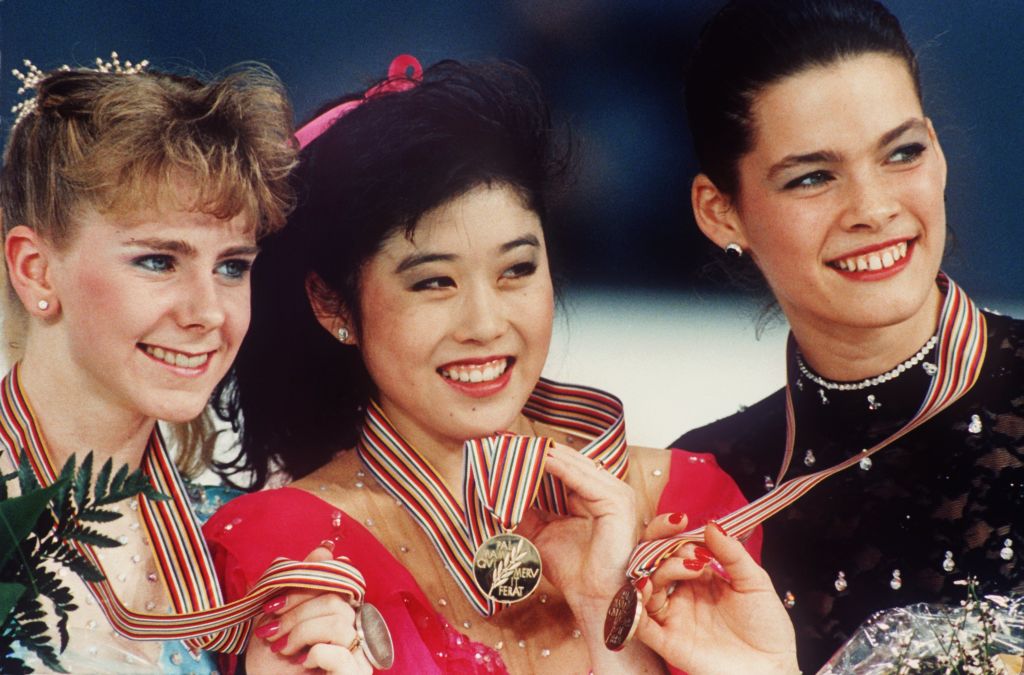
Kristi Yamaguchi
A mid-90s household name, Kristi Yamaguchi took gold at the 1992 Winter Olympics, making her the first Asian-American woman to win an Olympic figure skating medal. The cultural milestone subsequently opened doors for the next generation.
That 1992 win saw Yamaguchi overcome one of the deepest fields in Olympic history, beating a lineup that included the first and second women to ever land triple axels in competition: Japan's Midori Ito and fellow US star Tonya Harding. The 21-year-old was reportedly inspired by her childhood hero, as legendary figure skater Dorothy Hamill approached her backstage to wish her luck — moments before Yamaguchi pulled of her gold medal-winning run.
Nancy Kerrigan
Nancy Kerrigan overcame extraordinary adversity to win silver at the 1994 Lillehammer Olympics — just weeks after being attacked at the US Figure Skating Championships. While her bronze medal at the 1992 Albertville Games established her as an elite figure skating competitor, her 1994 comeback defined her legacy on and off the ice.
Kerrigan's grace under pressure and technical precision — particularly her signature spiral sequences — inspired millions and propelled figure skating into mainstream consciousness during one of the sport's most scrutinized and memorable eras.
Michelle Kwan
Michelle Kwan stands as the most decorated figure skater in US history. Despite never winning Olympic gold, Kwan captured silver at the 1998 Nagano Games and bronze in 2002, all the while revolutionizing creative expression in women's figure skating.
Her five world championship titles and nine US national championships represent unparalleled consistency and dominance across more than a decade of elite competition. Kwan's lyrical style and emotional depth transformed artistry expectations, influencing generations of skaters who followed.
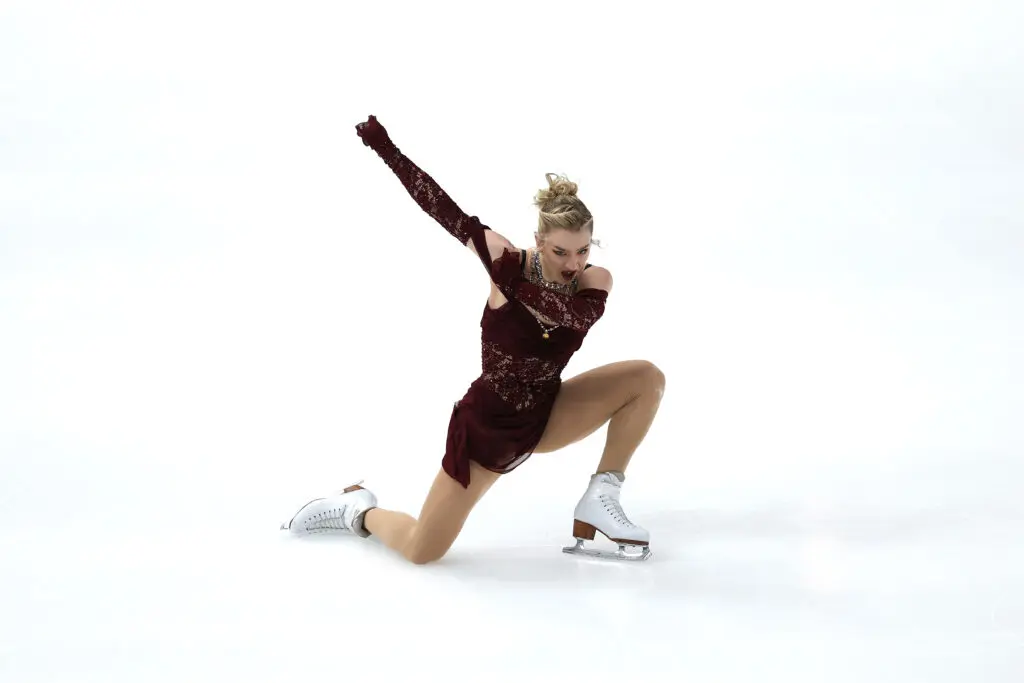
Tara Lipinski
At just 15, Tara Lipinski etched her name in Olympic figure skating history by becoming the youngest individual gold medalist at any Winter Olympics. Her groundbreaking triple loop-triple loop combination in the 1998 Nagano Games pushed the limits of the sport's physical boundaries. Lipinski's victory over favorite Michelle Kwan marked a generational shift in women's figure skating, as the field turned toward younger, more technically ambitious athletes. Currently a commentator for the 2026 Winter Olympics, Lipinski also remains the youngest world champion in history, winning the 1997 title at age 14.
Sarah Hughes
Sarah Hughes claimed gold at the 2002 Salt Lake City Olympics with a stunning free skate performance, rallying from fourth place after the short program to become the third US women's figure skater to ever win Olympic gold.
Hughes's calm under pressure — landing two triple-triple combinations — proved that artistic form and technical excellence could coexist at the highest level. And her upset victory over favorites Michelle Kwan and Irina Slutskaya continues to rank among the sport's most memorable Olympic moments.
Amber Glenn
The first athlete to win three consecutive US national championships since Michelle Kwan, Amber Glenn represents figure skating's modern era. The 26-year-old Texas native also became the oldest US women's singles competitor in 98 years when she took the ice at this year's Winter Games.
Known for her athletic prowess — and consistently landing triple Axels in international competition — Glenn has emerged as an important voice for inclusivity as an openly queer athlete advocating for greater representation and equity in the sport. Furthermore, Glenn's perseverance through years of near-misses before finally capturing her first national title in 2024 epitomizes her dedication to the future of figure skating.
Mikaela Shiffrin returned to the top of the podium Wednesday, as the US star won the women's slalom by a dominant 1.50 seconds at the 2026 Winter Olympics — her first medal since 2018.
The 30-year-old posted a combined time of 1:39.10 across two runs. Switzerland's Camille Rast took silver, while Sweden's Anna Swenn Larsson claimed bronze at age 34, becoming the oldest slalom medalist in Olympic history.
Shiffrin led Wednesday's race from the start. She posted 47.13 seconds in the first run, building a 0.82-second lead before going last in the second run and sealing the victory.
The victory ends an eight-year Olympic medal drought. She went nine consecutive events without reaching the podium, including six at the 2022 Beijing Olympics, where she failed to finish three races. In Cortina, she's finished fourth in the team combined and 11th in giant slalom.
Mikaela Shiffrin Leaves Her Mark on the Olympic Slopes
The slalom triumph mirrored Shiffrin's Sochi 2014 gold medal performance, won at just 18 years old. Now, 12 years later, she becomes only the second skier to win two Olympic slalom golds, joining Switzerland's Vreni Schneider.
"Maybe just today, I realized what happened in Sochi," an emotional Shiffrin said afterward. "It's crazy."
The gold also makes Shiffrin the most decorated US alpine skier in Olympic history, with three golds and four total medals. Additionally, she holds the record for most World Cup victories with 108 wins.