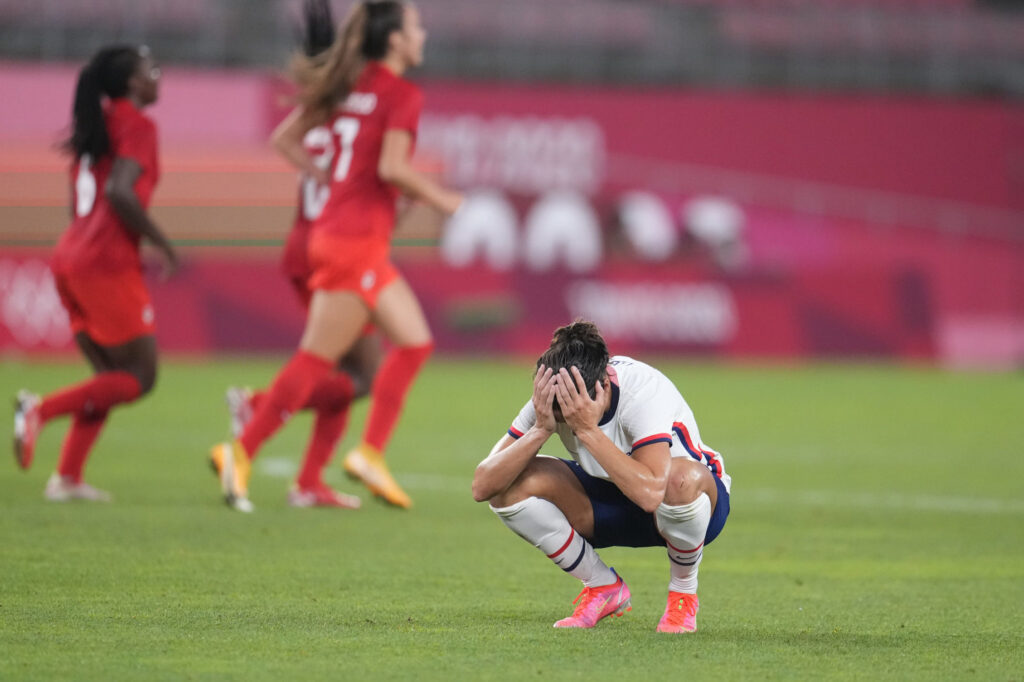
Even before the United States women’s national team suffered its first loss to Canada since 2001 in Monday’s Olympic semifinal, the No. 1 team in the world did not look like itself. From their first group-stage game against Sweden, resulting in a 3-0 defeat, the players struggled to string simple passes together, defend cohesively and score in the run of play. Their performance was especially jarring since the USWNT hadn’t lost a match before that since 2019.
The USWNT still has a shot at a medal in the third-place match against Australia on Thursday, but that hasn’t stopped the questions of what exactly went wrong for the gold-medal favorites.
It’s hard to diagnose the crux of the problem just one day removed from the semifinal; the players themselves aren’t even sure what led to them underachieving in Tokyo. What we do know is that the U.S. looked nervous and tense, lacking their usual freedom and joy on the pitch.
So for now, let’s evaluate a combination of factors that might have sent the USWNT down the path toward the bronze-medal match.
They might have been burnt out
The U.S. coaching staff intentionally placed the players in hot and humid conditions before they left for Tokyo.
The Summer Series in Houston in June was meant to replicate the brutal Olympic tournament schedule, with the games played in oppressive heat and on quick turnarounds. During the Send-Off Series in July, the team went through heat training at the University of Connecticut. The sessions were intended to regulate the players’ body temperatures and ensure they were acclimated to playing with a high heart rate for an extended period of time in the intense Japanese summer.
The USWNT went through those preparations to give themselves an edge at the Olympics. But while heat training can be useful to know what it feels like to ask that much of your body, overworking yourself can also exacerbate the problem.
As Megan Rapinoe told me before the team left for Tokyo, “That [Summer Series] camp was really difficult, and obviously the roster was being [chosen], I think just stress was in the air. We were in Houston most of the time. It was hot, it was in the middle of our [club] season. So it just felt a little like, whoa, and we’re in this bubble.”
Rapinoe described better spirits during the Send-Off Series, but Becky Sauerbrunn alluded to a more business-like approach in Hartford that might have haunted the USWNT later.
“I don’t think it’s really a relief,” she said. “Now it’s, ‘OK, what’s the work that needs to be done in order for us to be successful at the Olympics?’ It’s more like, ‘OK, one step down, 5,000 more to go.'”
Most USWNT players were in the middle of their NWSL seasons when they took off for Tokyo, only adding to their exertion in the months leading up to the Games. It all amounted to the players not looking like they had enough in the tank to influence matches in the way they’ve been used to in the past.
They might have been over-coached
Much has been made of second-year head coach Vlatko Andonovski’s hyper-pragmatism during this Olympic campaign, and whether it came at the cost of the team’s identity. After setting a tone in previous friendlies as a formidable pressing team, Andonovski had his team sit in a low block in their final group-stage match against Australia, and the players clearly struggled with it.
In both knockout-stage games, Andonovski also made complete three-player line changes in the attack. Subbing out tired players for fresh legs makes sense, but the style of the substitutions seemed to ignore who was playing well in that moment, thus stifling momentum. A team that normally prides itself on fluidity often looked like it didn’t know the right spaces to run into or the right passes to make.
In the Jill Ellis era, the USWNT operated with something of an A-team/B-team structure, where proven starters were given the biggest responsibilities in the most important games. Andonovski took a different approach in Tokyo, rotating his center backs in and out of the gameday 18 every time they hit 180 minutes played, and never settling on a front three. He did, however, rely heavily on some players and left quite a few on the bench. On the defensive wings, for example, Kelley O’Hara and Crystal Dunn were tasked with covering both for their teammates in front of them and for the center backs who occasionally got lost in transition.
The problems only worsened when the USWNT went down a goal to Sweden and Canada and fell into “Route One Football,” with the center backs lofting long balls toward the attack or wingers sending crosses into the box to no one in particular. Despite the team’s calculated approach, the players lost their composure too easily when the games weren’t going their way.
As a result, the USWNT’s margin of error was so thin that two saved penalties against the Netherlands sent them to the semifinals and a conceded penalty in the 75th minute of the match against Canada had the opposite effect, ending their hopes of a gold medal.
Not the result we wanted but not done yet. Still a medal to play for on Thursday 🇺🇸 pic.twitter.com/Dyo92I1hxP
— U.S. Soccer WNT (@USWNT) August 2, 2021
The roster might have been ill-balanced and out of form
When Andonovski announced his 18-player roster (plus four alternates) for the Tokyo Olympics, the overall health and age of the players selected caused concern. Julie Ertz and Tobin Heath were both coming back from injuries, and the team went into the tournament with by far the oldest roster, betting on experience over fresher legs. That strategy worked against less developed competition in the run-up to the Olympics, but when it came to their biggest tests against the Netherlands, Canada and Sweden, the USWNT went with a slightly different roster and a more aggressive tactical approach.
Ertz recovered rather quickly, which proved critical after Lindsey Horan’s performance in the No. 6 spot against Sweden left much to be desired. Heath also looked fit enough to hold onto her spot.
What the team couldn’t have planned for, however, were the other underachieving players on every positional line. Abby Dahlkemper struggled in multiple games to account for where she was in space. Sam Mewis and Rose Lavelle each had spells where they simply could not retain possession in the midfield. And the forwards, outside of Lynn Williams and Christen Press, had a hard time finding each other in front of goal. Andonovski deserves criticism for sticking with an aging roster, especially with the extra year between the World Cup and the Olympics, but it’s unclear whether even he could have anticipated the sudden dip in form across the lineup.
Another unanswered question is why Andonovski didn’t extend much playing time to role players on the roster — considered by many to be the deepest in the world — when the starters were struggling. Emily Sonnett started just one game, the team’s easiest in the group stage against New Zealand, despite the USWNT’s troubles at the right and center back positions. Catarina Macario and Kristie Mewis were given very little time in the midfield, and Casey Krueger was only brought in to relieve Crystal Dunn at outside back once.
It’s not unreasonable to stick with your veterans when the going gets tough, but it’s also fair to question how defined the roles on the outer rim of the roster actually were.
The team’s mentality might have gotten lost
From the first whistle of the Sweden match, the USWNT looked uncharacteristically listless and overwhelmed. Against New Zealand, they occasionally looked frantic. Against the Netherlands, they could only put their opponent on their heels in select parts of the first half. Against Canada, they looked mentally and physically exhausted.
This element of the team’s struggles in Tokyo is the most difficult to diagnose from the outside. Any of the factors listed above could have contributed to the mental shift, or they could be completely unrelated.
These Olympic Games have been cruel to the favorites in almost every sport — gymnastics, tennis, swimming, etc. The players and coaches have had to deal with the crushing pressure of expectations combined with strict quarantining protocols and no in-person support from family, friends and fans. The past year took a toll on everyone in different ways, and it’s possible athletes didn’t realize how much they were struggling until the tournament actually began.
Internal pressures can also get in the way of focus. For the USWNT, those might have included the desire to send so many iconic players into retirement on a high note, divisions within the team about issues of social justice and the running lawsuit with the U.S. Soccer Federation. We’ve seen time and time again how the intense desire to succeed can actually get in the way of doing just that. After all, the USWNT players — despite their fearsome reputation — are human.

Winning the Olympics in soccer might be really hard
This factor might come with the most controversy of all.
A number of quality teams participated in this Olympic tournament, each with a distinct personality and tactical plan. The Netherlands scored at will, Japan passed rings around opponents and Sweden disrupted teams in the midfield to send waves of pressure toward goal. Australia never quit, Brazil was ready for both scoreless grinds and shootouts and Canada relied on its fundamentals.
The idea that the rest of the world is catching up to the U.S. isn’t new, and it’s still hard to tell if this tournament was more evidence of that argument. What is clear is the USWNT played far below its own standard in Tokyo and still came close to squeaking into the gold-medal match.
Knockout-round soccer is exciting for a reason — the ball will take weird bounces, officials will make controversial calls, players will step up in miraculous ways, injuries will arise. It’s fair for fans of the USWNT to take a hard look at all the ways the team underachieved in Tokyo, but it also doesn’t do the other teams justice to assume the USWNT’s success is entirely in its own control.
As disappointed as U.S. fans might be by the team’s performance, the fact the USWNT can’t coast into the gold-medal game is a good sign for the sport. And if the U.S. does win bronze despite its struggles, that’s a feat worth celebrating.
If anything, the Olympics have served as a wake-up call for the USWNT, which could set them on the right path to the 2023 World Cup. Those in charge will evaluate the issues that need fixing and discard what doesn’t serve them, while the team will try to come home with some hardware. Then, the task of getting better starts all over again.