It didn’t take long for the Taliban to indicate women’s sports will once again be banned now that the regime has regained total control of Afghanistan. Earlier this month, Ahmadullah Wasiq, the deputy head of the Taliban’s cultural commission, told Australian broadcaster SBS, “Islam and the Islamic Emirate [Afghanistan] do not allow women to play cricket or play the kind of sports where they get exposed.”
The fact that the Afghan women’s cricket team and all other women’s national teams play in full length attire with hijabs is not sufficient for the Taliban’s interpretation of Islam.
“In cricket, they might face a situation where their face and body will not be covered. Islam does not allow women to be seen like this.”
But it’s more than just the risk of skin exposure and inappropriate attire that the Taliban have issue with. “It is the media era, and there will be photos and videos, and then people watch it,” Wasiq stated, indicating any type of public viewership or consumption of women’s sports is equally problematic for the extreme Islamist group.
It’s been 20 years since the oppressive regime was last in power. In that time, a generation of Afghan girls grew up with increased access to sports, and the country developed many national athletic programs for women.
In 2010, the New York Times reported Afghanistan had started national teams for women in 22 different sports, though many in fledgling stages. Fast forward a decade, and the situation in Afghanistan is once again bleak in almost all aspects, especially for women.
By taking a closer look at some of the sport programs they have worked so hard to grow over the past two decades, the magnitude of their impending loss is more fully realized.
Cricket:
The sport of cricket, for both men and women, is governed by the Afghanistan Cricket Board (ACB). After years of hard work, ACB became a full member of the International Cricket Council in 2017. One requirement for ICC membership is to have an active national women’s cricket team.
According to ACB’s 2020 annual report, tournaments for school age girls have been held from 2014 on. Using those school teams as the player pool, the ACB hosted a series of development camps throughout 2020, gradually narrowing down from 100 original attendees to selecting 40 of the most talented players to the final camp. At the end of the last camp in November 2020, the ACB selected 25 women to be the nation’s first female cricketers awarded professional contracts from ACB. One year prior to the Taliban regaining power, Afghanistan had named its first ever salaried national women’s cricket team.
Soccer:
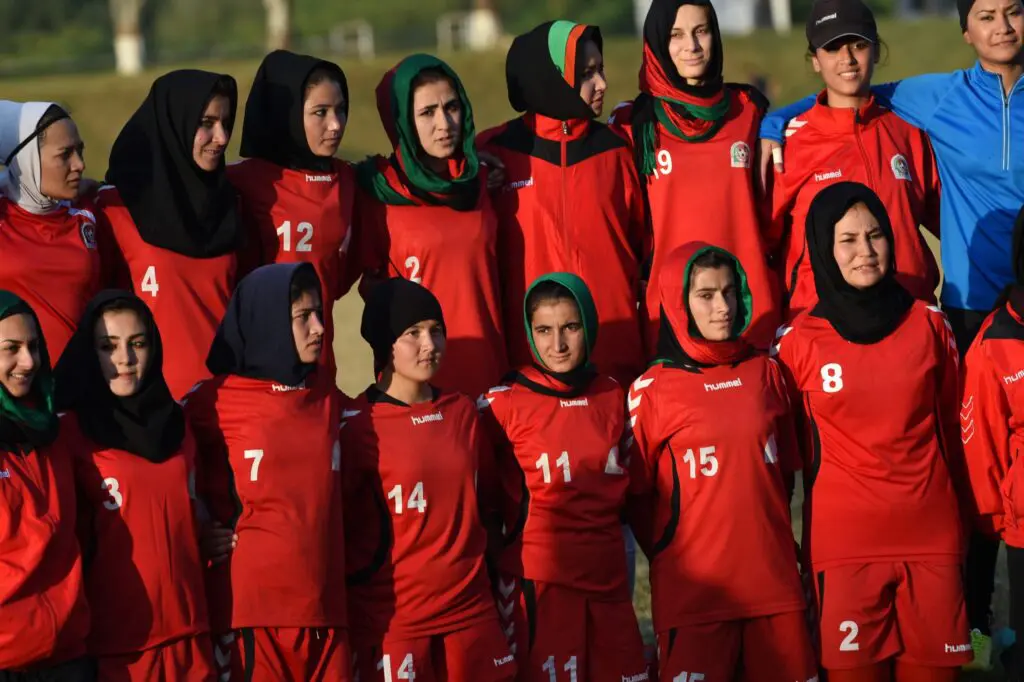
Similar to the selection process for cricket, a national Afghan women’s soccer team was first formed in 2007. Getting adequate support for the program has been an ongoing battle. Funding, practice space, quality coaching, and athletic training have continually been hard to come by, not to mention familial and community support.
For much of the team’s existence they practiced on a NATO helipad field that was enclosed from onlookers. The national team’s first official international match was in 2010 at the South Asian Football Federation (SAFF) Women’s Championship. The biannual SAFF Championship was the main tournament for the Afghan team until 2018, when the country switched membership to the Central Asian Football Association (CAFA). That same year several of the women’s players came forward with allegations of sexual and physical abuse by the Afghanistan Football Federation President, Keramuudin Karim.
Given all the hurdles they faced, it’s impressive how much they were able to grow the sport for girls and women in the country. By 2021, there were eight teams participating in the Kabul Women’s Football League. Winners from this league moved on to compete in the Women’s Champions League, where top teams from each province competed for a national title.
The harrowing evacuation of Afghanistan’s national team players has been well documented in recent weeks. In the past several days, further reports surfaced showing members of the junior national team and their families successfully made it to Pakistan and were housed by Pakistan’s Football Federation before flying to Portugal where they have been granted asylum.
Though the high number of women’s soccer players who have successfully emigrated is welcome news, there are masses of female footballers who will remain in the country under an oppressive ruling body that will go to great lengths to prevent them from setting foot back on the pitch.
Basketball:
Efforts to form a national women’s basketball team began shortly after the U.S. ousted the Taliban in 2001. But as late as 2012, the team still had a hard time finding legit opponents, often playing against school age youth teams.
In an effort to grow the sport, organizers began hosting an annual Afghanistan Women’s Basketball Championship in Kabul. In 2013, the tournament reportedly included over 100 players from 10 teams across three provinces and served as an opportunity to vie for a spot on the 12-person national team. One national team player, Samira Asghari, went on to become the first Afghan member of the International Olympic Committee.
Wheel-Chair Basketball:
One of the biggest sporting success stories in the country has been the development of the Afghan national women’s wheelchair basketball team. Created through a program run by the International Committee of the Red Cross, the team made huge strides from 2012, when they were too afraid to play with spectators, to 2017, when they won an international tournament in Bali. With solid support from the ICRC in the form of equipment, practice space, transportation, and coaching, the number of Afghan women playing the sport exploded, with 120 players on record as of 2017.
Handball:
In 2018, the first ever women’s national handball championship was held involving five teams from three provinces, serving as a selection event for the senior and youth national teams.
Track and Field:
Afghanistan has sent three female sprinters to the Olympics since 2004. In June 2021, 60 athletes competed across six running events to qualify for the Women’s Athletics National Team. In Tokyo, flagbearer Kimia Yousofi set a national record for women in the 100M sprint.
Martial Arts:
In 2004, one of the first two female Olympians from Afghanistan was judoka Friba Rezayee. The 2021 women’s national taekwondo tournament held in Kabul featured 50 athletes.
Volleyball:
Afghanistan holds a national women’s volleyball tournament every year, and earlier this year an Iran-based Afghan refugee team won the 2021 title, beating a city team from Kabul in the final. Ten teams participated.
Cycling:
In late 2020, two female freestyle cyclists were named to the Afghan Cycling National Team.
– – –
The Taliban have yet to make any formal statement regarding the future of women’s sports in Afghanistan, but given the regime’s history, public comments from a high ranking official, and the fact no women were included in the new cabinet, the outlook is not good.
Documenting the sports programs Afghan women bravely pursued over the past two decades is one small way to say, “We see you. We support you.”