All Scores

Natasha Hastings wouldn’t let pregnancy end her track career

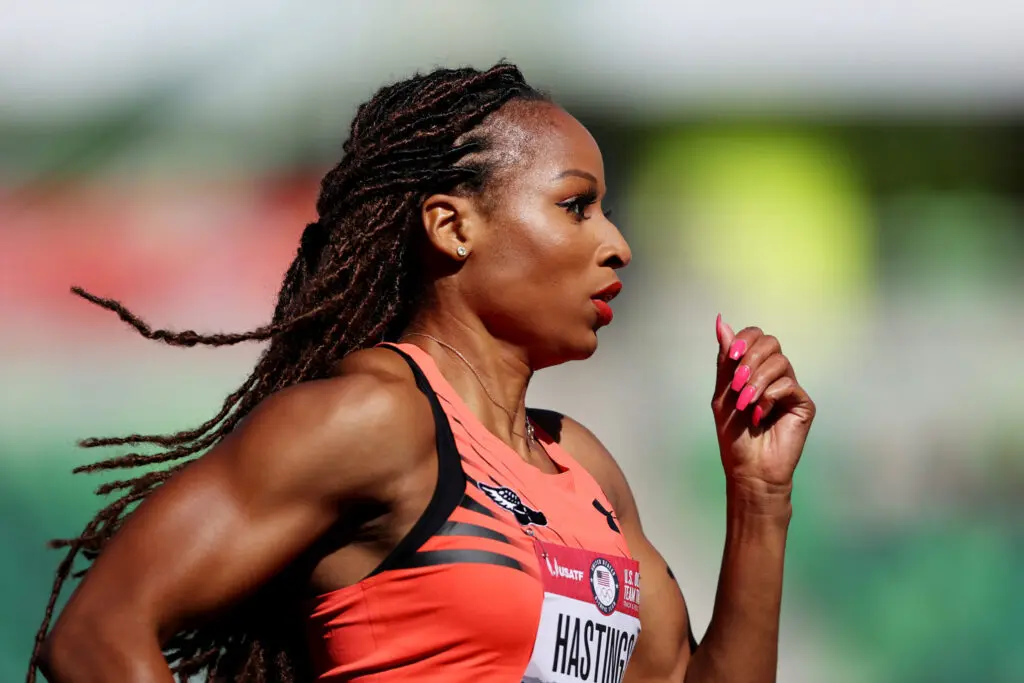
Natasha Hastings competes in the 400 meter during the U.S. Olympic Track & Field Trials last June. (Patrick Smith/Getty Images)

For the first five months of her pregnancy, two-time Olympic gold medalist Natasha Hastings was terrified to tell her sponsors that she was expecting. Yes, the opportunities available to female athletes had improved a lot in her lifetime, but having a baby was still referred to as the “kiss of death” in elite running circles.

“The truth is that every single minute of the first five months I’d been pregnant, I was terrified,” she revealed in a 2020 op-ed. “I was worried about how it would change my fitness, my body. What would it look like, feel like, when I came back? What did this mean for coming back for the Olympics? What did this mean for the rest of my track career? Would I effectively have a career at all?”

Born in 1986, Hastings is a classic product of Title IX, the 1972 legislation guaranteeing equal access regardless of gender and celebrating its 50th anniversary next month.

After exploding onto the scene at the 2003 USATF Junior Olympics, the New York native earned an athletic scholarship to the University of South Carolina, where she was the indoor and outdoor 400M national champion her junior year. Turning pro in 2007, Hastings went on to win gold medals with Team USA in the 4×400 relay at both the 2008 and 2016 Olympics.

In 2019, she was laser focused on qualifying for Tokyo. She envisioned it as her third and final Olympic games, an opportunity to bid farewell to the sport that had given her so much and that she had given everything to. And then she found out she was pregnant.

In addition to her fears about the physical impact on her body and performance, Hastings worried that people would question her commitment — that choosing to become a mom signaled to the world she was not 100 percent invested in her running career. From Hastings’ point of view, there were hardly any examples of elite runners whose careers weren’t derailed by having children, and plenty of examples of those who were affected, including her own mother.

“My mother, Joanne Hastings, was once a world-class 200-meter sprinter herself during the early to mid-Eighties,” Hastings wrote. “She was a record-setting star in college and made the 1984 Olympic team for Trinidad & Tobago. After I was conceived, however, her career as an athlete was over.”

After putting it off for as long as she could, Hastings finally picked up the phone and called Under Armour to tell her title sponsor she was having a baby. It was a huge weight off her shoulders when they responded with positive support and excitement. Looking back on the conversation later, Hastings realized that having women in leadership roles was key to the end result.

“When I was signed to Under Armour, a woman signed me. When I made the call to Under Armour to tell them I was pregnant, I made that call to a woman,” Hastings said. “It’s important for women to be telling our stories and making decisions for us. A lot of times, women are left out of the conversation because the people making the decisions don’t look like us, don’t understand us.”

img
Hastings trained for the Tokyo Olympics at home during the pandemic after giving birth to her son. (Tom Pennington/Getty Images)

Hastings had well-founded reasons to worry about her sponsor’s reaction. Within a couple of weeks of her conversation with Under Armour, several Nike runners went public with complaints that the company had reduced their pay or suspended their contracts when they could not compete during and after pregnancy. Among the complainants was Allyson Felix, the most decorated American track and field athlete in Olympic history. In a powerful piece for the New York Times, Felix detailed her frustrating negotiations with Nike over maternity protections that ultimately caused her to walk away from the table completely.

After the stories came out about what pregnant female runners were dealing with, Under Armour called Hastings again to check on her and open up a dialogue about the stress she felt before telling them.

In August 2019, Hastings gave birth to her son Liam and got back to training within weeks, as she still had her sights set on Tokyo. When the pandemic further derailed those plans, Hastings continued to train as best as she could at home. But when she eventually stepped to the line at the U.S. Olympic Trials in June 2021, Hastings did not qualify for Tokyo.

Days after her heartbreaking finish, Hastings told Self Magazine, “There are two things that I’m thinking about when I think about what I want to do going forward. Am I emotionally able to do this again, and am I physically able to do this again?”

Whether or not she decides to continue pushing her body to reach maximum speed and aim for a future final farewell on the track, Hastings knows that, regardless of becoming a mom, running doesn’t last forever.

Now a graduate assistant coach for her alma mater, where she is pursuing her master’s degree in clinical mental health as well as running her own foundation and raising her son, Hastings is one of many changing the image of professional female athletes. As more women are starting families well before their athletic careers are over, they are looking closely at their leagues, their collective bargaining agreements, their contracts and their brand endorsements and pushing for the necessary changes.

“I am definitely encouraged by seeing the number of athletes that are willing to use their voice and platform,” Hastings told Essence Magazine last year. “I think we all can agree as women and as Black women, a lot of times our experiences are minimized, or we’re being told that we’re being dramatic.”

As a result of female athletes speaking out, leagues around the country have implemented new progressive pregnancy and maternity leave policies.

In 2019, after Felix and her colleagues spoke out, Nike announced an 18-month contract protection period during and after pregnancy for sponsored athletes. The WNBA’s 2020 CBA included fully-paid maternity leave, two-bedroom apartments for players with children and a childcare stipend. The following year, the league granted access to free fertility testing for all players. The NWSL Players’ Association, in its very first iteration of a CBA this year, secured eight weeks of paid parental leave for both birth and adoption. And Athletes Unlimited last year guaranteed paid leave for pregnancy and postpartum recovery for as long as needed during the season, as well as parental leave for adoption and for any player whose partner or spouse gives birth.

Having a child was once an imposed finish line for female athletes, like Hastings’ mom Joanne. But Hastings’ generation of women, who came of age after Title IX and were raised on the promise of equal opportunity, have carried that standard into their careers as pro athletes and into motherhood, changing the sporting landscape for generations of women to come.

Tessa Nichols is a contributing writer at Just Women’s Sports.
US Soccer Adds 14 Host Stadiums to 2031 World Cup FIFA Bid Book

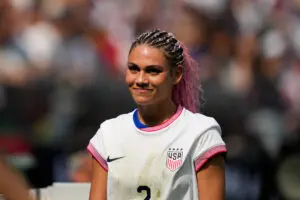
USWNT forward Trinity Rodman and defender Tara McKeown stand on the SoFi Stadium field before a 2025 friendly.
US Soccer tapped LA's SoFi Stadium as one of the host venues for the 2031 World Cup. (Brad Smith/ISI Photos/USSF/Getty Images for USSF)

US Soccer submitted its World Cup bid book to FIFA last week, naming 14 US stadiums among the 2031 tournament's 20+ proposed North American host venues.

The four-country joint bid for the 2031 World Cup spanned cities across host nations USA, Mexico, Costa Rica, and Jamaica, with the quartet collectively identifying 50 potential stadiums while also designating their proposed core of 20 venues.

In the US, stadiums in Atlanta, Charlotte, Houston, Los Angeles, Kansas City, and Seattle made the proposed shortlist, as well as Arlington, Texas, and East Rutherford, New Jersey, among others.

Mexico City, Guadalajara, Monterrey, and Torreón made Mexico's primary proposal, while Costa Rica and Jamaica put forward San Jose and Kingston, respectively.

The bid includes both soccer and football venues, with secondary venues also listed as possible options in eight of the first-choice US cities.

Additionally, the bid book pegged Atlanta as the World Cup draw host and Dallas as the tournament's international broadcast center, though FIFA will likely not make final decisions on 2031 venues until after the 2027 competition in Brazil.

"By proposing more than the required 20 sites, the joint bidders demonstrate a commitment to securing the best possible hosting conditions and ensuring the tournament represents the full diversity of our region on a global scale," FIFA stated.

WNBA, Players Union Agree to 40-Day CBA Extension

A WNBA basketball rests on the court during a 2025 game.
Under the latest extension, the WNBA now has until January 9th, 2026, to ratify a new CBA. (Luke Hales/Getty Images)

The WNBA and WNBPA agreed to a second CBA extension late Sunday night, officially pushing the contract's deadline to January 9th, 2026, to allow for 40 more days of negotiations.

Like the original CBA extension from October 31st to December 1st, either the WNBA or WNBPA now has the option to terminate the agreement with 48 hours of notice.

"We expect substantive movement from the league within this window," the players union told Front Office Sports, while the WNBA issued a statement saying both parties are "continuing to work toward a new agreement."

While total annual compensation offers have reportedly crossed the million-dollar mark for players earning the league's maximum, the WNBA's salary model — particularly in regards to revenue sharing — remains a core issue.

According to sources, the WNBA's proposal offers players a revenue-sharing option only after reaching certain minimums, while the WNBPA continues to advocate for a bigger cut of the exponentially growing league.

The players union is also reportedly advocating for a salary cap that increases with the league's income, rather than at an arbitrarily fixed growth rate.

With important offseason processes like the planned two-team expansion draft to stock incoming 2026 WNBA franchises the Portland Fire and Toronto Tempo now delayed until a new CBA is in place, the pressure is approaching new highs on both sides of the negotiating table.

Texas Tops UCLA, South Carolina to Win 2025 Players Era Championship

Texas guard Rori Harmon drives to the basket against South Carolina during the 2025 Players Era Championship final.
Texas guard Rori Harmon hit the game-winner in the 2025 Players Era Championship on Thanksgiving Day. (Andrew Wevers/Players Era/Getty Images)

No. 4 Texas blew past two top-ranked opponents last week, setting the tone for the 2025/26 NCAA basketball season with back-to-back wins over No. 3 UCLA and No. 2 South Carolina to earn the Players Era Championship trophy on Thanksgiving Day.

Fifth-year senior Rori Harmon was named tournament MVP, putting up a game-leading 26 points and breaking the Longhorns' career assists record in Wednesday's 76-65 defeat of UCLA before hitting the game-winner to lift Texas over the Gamecocks 66-64 in Thursday's title game.

"I just read the vibe and flow of the game," Harmon said afterward. "[Texas head coach Vic Schaefer] called the play at the end of the game, and I've been in this moment before, so it felt good coming out of my hands."

Texas's win added fuel to the burgeoning SEC rivalry, with the teams squaring off five times in the last year — and South Carolina riding a narrow 3-2 advantage.

"I'm not upset at all," Gamecocks coach Dawn Staley said postgame. "This is going to help us because there are a lot of things to unpack in it."

"If you can give [Texas] a run for their money in that way, I mean, you're on to something," she continued. "I like our resiliency. We've just got to clean up some things at the end of the game."

How to watch Texas, South Carolina this week

Both Texas and South Carolina have another ranked matchup on this week's NCAA docket, with the No. 4 Longhorns taking on the No. 12 UNC Tar Heels while the No. 2 Gamecocks face the No. 23 Louisville Cardinals.

Both games tip off at 7 PM ET on Thursday, with Texas vs. UNC airing live on ESPN2 while South Carolina vs. Louisville airs on ESPN.

USWNT Caps 2025 Schedule with 2nd Italy Friendly

USWNT midfielder Rose Lavelle addresses her teammates in a huddle before a 2025 friendly.
The USWNT will shoot for their ninth win in 10 matches when they take on Italy again on Monday night. (Brad Smith/ISI Photos/USSF/Getty Images)

After a year of testing and experimentation, the USWNT will look to close out 2025 on a high note on Monday night, when the world No. 2 squad faces No. 12 Italy in the second of the pair's winter friendlies.

"I've been very clear on the process to develop players and what we have to go through, so I'm not zoomed in on three losses," US manager Emma Hayes said of the team's 2025 shortcomings. "If I was, I wouldn't make changes."

"We work in an environment we're really proud of," she continued. "It's a very inclusive environment, diverse environment, and all these things contribute to the culture that hopefully leads to long-term success."

In line with her ongoing rotational philosophy, Hayes indicated that fans in Fort Lauderdale on Monday could see a departure from the combination of players that defeated Italy 3-0 in Orlando on Friday — as well as new tactics from the 2025 Euro semifinalists.

"My whole argument is that no matter who plays, the level of performance should still be high," Hayes said.

The US saw 16 players debut this year — the most since 1985 — with 51% of the team's combined 39 goals and 26 assists in 2025 involving a player under 25 years old.

How to watch the USWNT vs. Italy on Monday

The 2025 finale for the No. 2 USWNT will see the national team kick off against No. 12 Italy at 7 PM ET on Monday, with live coverage airing on TNT and HBO Max.