All Scores

How the Phoenix Mercury built a model WNBA franchise over 25 years

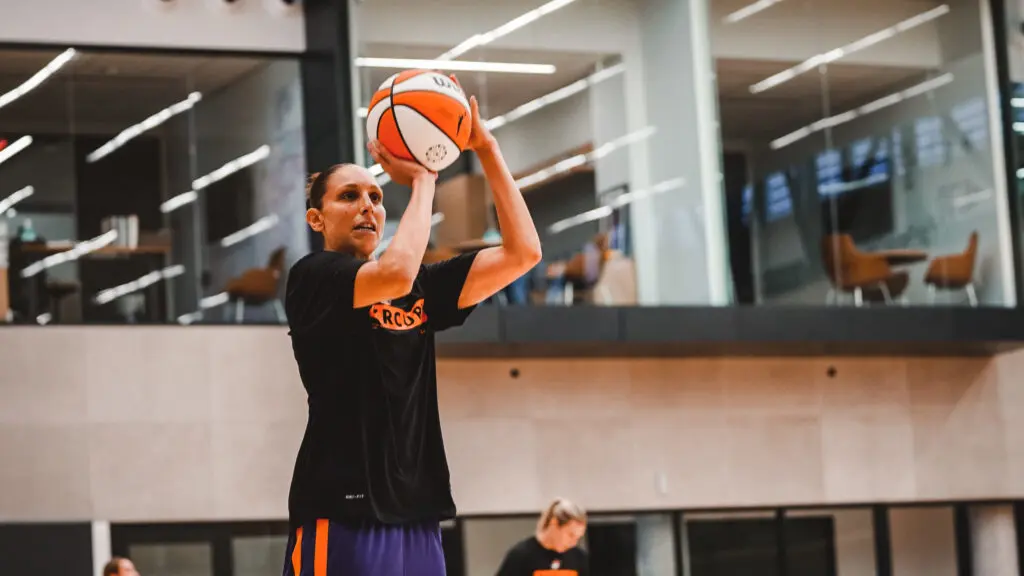
Diana Taurasi puts up shots at the Mercury’s new training facility shared with the Suns. (Phoenix Mercury)

By the time Robert Sarver officially became majority owner of the Phoenix Mercury and Phoenix Suns in 2004, Diana Taurasi was a couple of months into her first pro season. The No. 1 pick of the Mercury in that year’s WNBA Draft, she would go on to finish sixth in the league in scoring and be named Rookie of the Year.

It was just the start of Taurasi’s WNBA career, one of the most storied in the league’s 25-year history. And for Sarver, a first-time sports team owner, Taurasi’s arrival that year was fortuitous.

“That was just luck on my part,” Sarver told Just Women’s Sports. “It’s likely I won’t ever have another player like that on my team. She is not only great for our franchise, but great for the sport.”

Lucky as it may have been, what Sarver set out to accomplish from there was purely intentional.

The Mercury, one of four remaining original WNBA franchises, captivated Sarver from the beginning. A lifelong Arizona resident and businessman, he says he went to games and got to know the players over the years, inviting them over to his house for cookouts.

So, when Sarver started looking into buying the NBA’s Suns from owner Jerry Colangelo, he also saw a unique opportunity for growth with the Mercury.

The organization had a tradition of success, having reached the playoffs in three of its first four seasons under coach Cheryl Miller. Building championship-level teams from that foundation, Sarver believed, would help grow the game for girls and women in the community. And Taurasi, a franchise-changing talent, would lead them there.

“We were able to use the entire weight behind the Suns’ organization to help develop the Mercury and take it to another level,” Sarver said. “I would say we kind of over-sized the allocation of resources in order to help build up the team and the organization because it was like a new business, the WNBA. It’s still relatively new for professional sports leagues, but back then it was only seven years old.”

img
Robert Sarver presents Taurasi with her 2014 championship ring. (Barry Gossage / NBAE via Getty Images)

With Sarver’s backing, the Mercury were the first WNBA team to sign a marquee jersey sponsorship deal with Lifelock in 2009. They’ve had jersey sponsorships every year since then, including a badge deal with PayPal starting in 2019.

Last November, the organization unveiled a $50 million, state-of-the-art training facility that the Suns and Mercury share. Funded by Sarver, the Verizon 5G Performance Center includes a gym, weight training, performance analytics and biometrics, a rest and recovery zone and nutritional services. Taurasi spent this past offseason training at the facility rather than playing another season overseas, as many WNBA players do to supplement their salaries.

“I feel like we’re on par with the Suns and how they treat us professionally on the business side of things,” Taurasi said. “I think we have that business support that a lot of teams don’t have in the WNBA. And you can tell when you come to our arena and you drive around the city of Phoenix, we’re a presence in the community.”

Taurasi signed a two-year extension with the Mercury in February and says she’ll keep playing as long as she still feels a drive to compete. The 38-year-old has won three WNBA championships and two Finals MVPs in Phoenix, but still wants to add to her legacy.

It helps that the Mercury have been able to recruit and retain stars like Brittney Griner, their No. 1 draft pick in 2013, and Skylar Diggins-Smith, who signed with Phoenix last offseason. All three players are making the WNBA’s maximum salary this season and next, before Taurasi and Griner become unrestricted free agents in 2023. The Mercury also traded for All-Star Kia Nurse in February and have developed 2019 first-round pick Brianna Turner into a frontcourt mainstay.

img
Skylar Diggins-Smith (Phoenix Mercury)

Between the roster continuity and on-court product, the Mercury have built one of the most loyal fan bases in the WNBA. They’ve finished in the top three for average fan attendance every year since 2013, per data from Across the Timeline, and they retained 96 percent of their season-ticket holders through the COVID-19 pandemic.

“They’re hardcore, too,” Taurasi said of the fan base. “Some seasons have been rough and they’ll let you know about it, but there’s nothing like having fans that are invested emotionally and want their team to win.”

This year, Phoenix fans will get to enjoy the championship game of the WNBA’s inaugural Commissioner’s Cup, an in-season competition that awards $500,000 in prize money to the winning team. The final game will be held at Phoenix Suns Arena on Aug. 12 and streamed on Amazon Prime as part of the league’s new multi-year partnership with the platform.

To WNBA commissioner Cathy Engelbert, having Phoenix host the first Cup championship is fitting as the league celebrates its 25th year.

Engelbert has been asked repeatedly about the possibility of expanding the WNBA beyond its current 12 teams to create more room for talented players. An organization like the Mercury, she says, represents the standards of success the league would be looking for in future teams.

“If you’re going to expand, you have to find markets where women’s basketball will be supported, where you can build a loyal fan base and, with appropriate investment, you can make it a very successful franchise,” Engelbert said. “That’s how we think about using the Mercury as a role model for how to build a franchise and sustain it for, now for them, 25 years.”

Taurasi has been an integral part of both the investment and the payoff during her 17 years in Phoenix. And for now, as the Mercury get set for their home opener against the Connecticut Sun on Friday night, she doesn’t see herself finishing her career anywhere else.

“I just think it’s a special place to be,” Taurasi said. “This organization is committed to the Mercury and to winning, and those are two things that I value very strongly, that loyalty.”
LOVB Scores Weekly Primetime Broadcast Deal with USA Network

LOVB Austin poses for a photo after winning the 2025 LOVB Championship.
Coverage of the 2026 season of LOVB will air on USA Network beginning on January 7th. (Emilee Chinn/LOVB/Getty Images)

LOVB volleyball is coming back to cable, as the pro volleyball league announced a Wednesday night primetime partnership with USA Network for its 2026 season.

From January through April, USA Network will air a "Match of the Week" nearly every Wednesday evening, starting with a 2025 championship rematch between runners-up LOVB Nebraska and title-winners LOVB Austin on January 7th, 2026.

USA Network will also broadcast a portion of LOVB's 2026 postseason, including one semifinal and both games in the league's new two-match championship series.

Gearing up for its second season, LOVB features a talented player pool amid an increasingly crowded pro volleyball market.

One in every five LOVB athletes are Olympians, with 90% of the league's international players and 75% of its US players boasting national team experience.

Even more, growing demand for the sport has expansion on the horizon for the six-team league, with LOVB preparing to launch its seventh franchise in Los Angeles — backed by Angel City and Chelsea FC investor Alexis Ohanian — in 2027.

How to watch the 2026 LOVB season on USA Network

The second season of LOVB opens when inaugural champions Austin take on runners-up Nebraska at 6 PM ET on January 7th, 2026.

Live coverage will air on USA Network.

Panini Drops Exclusive ‘Caitlin Clark Chronicled’ Trading Card Set

A cover image of the limited edition Caitlin Clark Chronicled release.
The Caitlin Clark Chronicled collection includes a 22-page book and set of 100 trading cards. (Panini America)

With the rookie card of Indiana Fever star Caitlin Clark still doing numbers, trading card manufacturer Panini America is debuting Caitlin Clark Chronicled this week, dropping a limited-edition release on Monday that features a 22-page collectible book and 100-card set of the WNBA standout.

The book spans images of Clark on and off the court, and includes eight four-card packs and 32 randomly inserted trading cards, as well as autographed exclusives.

"I'm excited to launch 'Caitlin Clark Chronicled' with Panini America and share some of my favorite moments on and off the court from my first two years in the WNBA," Clark said in Monday's statement. "We wanted to create something different that combined great photography with trading cards, including some special exclusives. I am proud of this collection and hope fans enjoy it."

The WNBA superstar is an exclusive Panini partner in the trading card and autographed memorabilia space, with Clark making headlines last July when her one-of-one autographed rookie card sold for more than $600,000 — setting a new world record for a women's sports card.

How to buy Panini's 'Caitlin Clark Chronicled' card set

Panini's limited edition Clark collection is currently available for purchase at Target stores and Target.com.

Report: WNBPA Doubles Revenue Share in Latest CBA Proposal

Indiana Fever star Caitlin Clark wears a T-shirt saying "Pay Us What You Owe Us" before the 2025 WNBA All-Star Game.
The most recent WNBPA CBA proposal advocates for a revenue share with the WNBA near 30%. (Steph Chambers/Getty Images)

Tensions remain high between the WNBA and WNBPA, after The Athletic reported on Monday that the latest CBA proposal from Players Association more than doubles the league's revenue share offer — suggesting a deepening rift in negotiations.

The union outlined a deal that would give players around 30% of total WNBA and team revenue — a significant leap from the league's proposed 15% share.

According to sources, the WNBPA also suggested linking the salary cap to the previous season's total revenue, factoring in player benefits and the number of teams in the league.

The move intends to undercut an accusation from the WNBA that the players have yet to put forward an economically viable revenue sharing model.

The union's proposal begins at 29% of the prior season's total league grosses, then grows to 34% by the final year of the CBA with a one-time adjustment for the new 11-year, $2.2 billion WNBA media rights deal.

Notably, the league recently rejected a flat 33% revenue share CBA proposal, prompting this week's 1%-per-year increase system in response.

It's clear that the WNBA office and the WNBPA are at odds, but the union is showing their work as both sides strive for a CBA that will keep players on the court in 2026.

US Swimming Icon Katie Ledecky Clocks 1st-Ever Sub-15 Minute Women’s Mile

USA swimming legend Katie Ledecky celebrates after winning the 800-meter freestyle at the 2025 World Aquatics Championships.
Olympic swimmer Katie Ledecky smashed her own 1650-meter freestyle US record with a world record on Sunday. (DBM/Insidefoto/Mondadori Portfolio via Getty Image)

Olympic swimming icon Katie Ledecky has done it again, becoming the first woman to break the 15-minute mile with a time of 14:59.62 at her namesake Katie Ledecky Invitational in Maryland.

Smashing her own US record of 15:01.41, Sunday's sub-15 minute mile gives Ledecky the 1,650-meter freestyle's eight fastest times, with US teammate Erica Sullivan earning the ninth-best in 2019.

"This is a special one for sure," Ledecky said afterwards. "This has been a goal of mine, to break 15 minutes in the 1,650, for probably eight or nine years. So, just putting in the hard work, believing that I could do it someday, and to do it at this meet, is really special."

The 28-year-old Washington, DC, product is the most decorated women's swimmer in the history of the sport, prompting Nation's Capital Swimming — where Ledecky got her start at age six — to name their annual event in her honor earlier this year.

"I definitely was a little nervous before the race, just knowing there were a lot of eyes on me and all that," she continued. "But I knew I could just relax and have fun with it, and whatever happened, happened."

How to watch Katie Ledecky in action

Ledecky's next major competition will likely be the TYR Pro Swim Series, which kicks off in Austin on January 14th, 2026.

The domestic competition series will be covered across NBC Sports platforms.