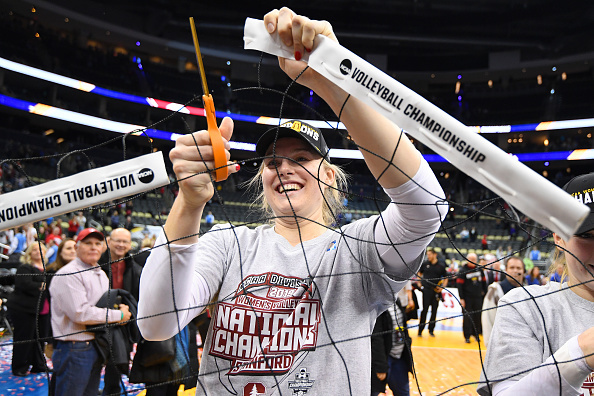
A member of the U.S. Volleyball and Beach Volleyball National team, Kathryn Plummer is the only player in history to have won FIVB World Championship medals in both beach and indoor. In 2019, Plummer was part of the US national team that won the Pan American Cup in Peru. An alum of Stanford University’s volleyball and beach volleyball teams, Plummer is a three-time NCAA champion and a recipient of the James E. Sullivan Award, which is annually given to the best American amateur athlete. Most recently, she played for the Italian professional volleyball team Saugella Team Monza.
After graduating from Stanford shortly after winning your third NCAA championship title, you chose to join a professional volleyball team in Italy. What made you decide to play overseas?
For women’s volleyball, there’s not much opportunity to play professionally in the United States as of now. The Italian professional volleyball league is very competitive – I knew I would be surrounded by the best players in the world. I wanted that challenge.
Playing Italy was definitely a challenge. First of all, it’s a challenge in and of itself to be away from home: You’re in a whole different culture, people are speaking a different language. You’re being coached in a different language. Additionally, the process of transitioning from a collegiate athlete to a professional player is quite a process. From finding an agent to finally negotiating a contract there were various steps involved before I finally got to visit the team. Between the NCAA semifinal and the championship during my final season at Stanford, I squeezed meetings with four or five agents in my hotel room all while preparing for the national championship.
With all this said, I’m glad I got to go to play overseas. I’m young, and I want to learn new things.
How was your season affected by the pandemic? What are your plans moving forward?
By the end of February, our games started to get postponed, and competing seemed no longer to be an option. At that point, pretty much all we could do was just practice, and I ultimately made the decision to return home in the United States. The league was officially canceled when I arrived back in the U.S.
Hopefully, I will be able to play next season, but with various international tournaments that were originally planned for this summer have been canceled much is up in the air.
Ok. So let’s backtrack a little bit to when you first started playing volleyball. Did you grow up playing both beach and indoor volleyball in high school?
Growing up, I was the “sporty” girl. I played basketball, soccer, softball – everything that you could imagine.
I grew up in Southern California, where men’s volleyball is a big part of the culture. My older brother played volleyball. I was the little sister that wanted to go to everything, all the practices, all the games. In a way, I was kind of forced into watching it. I decided to try it myself and first started playing volleyball when I was 10. I really loved it, and soon began to exclusively dedicate my time to the sport … Although I guess in high school, I was on the track and field team, but it was more of a hobby than anything else.
Were you really tall as a kid or did you hit a growth spurt later on?
Yeah, I was really tall. My parents are 6’8″ and 6’3″, and my brother is 6’7″. We’re a very tall family.
You were recruited by various universities. What made you ultimately decide to go to Stanford?
My recruiting process started pretty early – I got my first offer in the seventh grade. Academics and athletics are most important to me, and Stanford excelled in both.
But the thing that drew me in the most was that when I visited Stanford, I felt that I could be myself. Everyone at Stanford is kind of quirky, and weird – they all have their own little thing that makes them unique. At other schools, I felt like I was trying to put on this facade to fit in with their program, but at Stanford, everyone was different in their own ways – I felt like I could really thrive there.
Well you definitely did thrive over there! You started your Stanford athlete career by winning a national championship your freshman year. What was that experience like?
I’ve talked about this with my teammates from class many times – it was kind of a blur. I think we were just immensely joyful.
The other championships that we won together throughout our Stanford experience felt different than our first. Our freshman year was one of just pure happiness because we were giddy freshmen that didn’t really know the gravity of what we had accomplished. We were following a lot of senior leadership.
What type of expectations did you set for yourselves following such a great first season?
As a team, we talked about trying to not listen to the expectations that other people were putting on us. The next three years, I think we pushed ourselves for a strong season because we knew that we could hold ourselves to high standards, as opposed to pushing ourselves to meet any sort of external pressure cast upon us.
In your second season at Stanford your team’s campaign to the finals was cut short after losing to Florida 3-2 in the NCAA semi-finals. What was that experience like?
Pretty much throughout my entire sophomore season, our team breezed through. We had a tough preseason – we did really well. We had a tough conference – we did really well.
I think by the NCAA championships, we let the expectations that were set upon us starting from our successful 2016 season creep in a little bit. We didn’t feel like we were just playing a volleyball game – we felt the pressure to follow up a championship win from the previous year.
We just weren’t a cohesive group. Both Florida and Stanford played good volleyball, but our competitor was more of a cohesive team than we were.
Following the season, we sat down and really tried to bring together our whole team. We sought to find ways to support every member of our team – I thought this was really important and allowed us to have a lot of success the next two years.
You won three national championships during your time at Stanford. Is there one that is most memorable?
I definitely think my senior season was the most special. All of the seasons were really awesome, but senior year was most memorable because it was the last time I was in a Stanford uniform, the last where my parents watched me play in college and the last I was going to get to play together with my teammates. It was a very bittersweet, happy yet sad moment. My teammates and I were crying because we were happy that we won the championship, but also sad because we knew it was over. Our whole four years – and everything we built in those times was over.
Why do you think your class on the team has been so successful as a unit?
We were best friends off the court too, which is nice, but that is by no means necessary to have a successful team. I think we embraced different leadership roles on our team. As for myself, I tried to lead by example – I tried to figure out how to score. Other people had different types of leadership styles: For example, Morgan Hentz was a leader that kept everyone accountable; She made sure that everyone was doing their job. Jenna Gray was the goofy one that lightened the mood when it was too tense. Audriana Fitzmorris was the very intellectual, analytical one. Everyone came together to form a very cohesive group. We worked really hard to figure out ways to support and communicate if people were struggling. There were many tough conversations in the process, but I think it came together at the end.
What was your academic experience like at Stanford? Stanford is a very academically competitive institution as it is athletically – was anything particularly challenging?
I studied Human Biology. My sophomore year was tough, because I was taking the core classes for my major which was hard.
But after that, I really liked my courses, because I could take the classes that were very applicable to my interests. I’m very interested in how the body works in exercise and sports. I took a bunch of anatomy and human performance classes, which was really cool. As an athlete, I started to understand my own body better at the biological and molecular level.
You also played on the Beach Volleyball team as a freshman and sophomore at Stanford. How did you balance playing two sports?
It was tough to play competitively for two seasons in one academic year, but it was also nice to be able to get a little breath of something fresh. It was really tough in the winter quarters, because I was practicing for both indoor and beach.
I eventually made the decision that I wanted to start my professional career in indoor and maybe transition to beach later on in my career, because beach is a lot more forgiving to your body when you’re older. So, following my sophomore year I solely focused on playing for the indoor team.
What are your future goals for the sport?
Since I was little, it has been my dream to go to the Olympics. I’m going to be playing professionally at least until 2024. There’s a lot of things that will unfold up until that point, but I want to try to make the Olympic team. Then we’ll see what I want to do, but that’s way far away. There’s always a professional career in beach volleyball – you can get paid for that, which is nice. I also just might have a normal job and work in an office. Who knows?