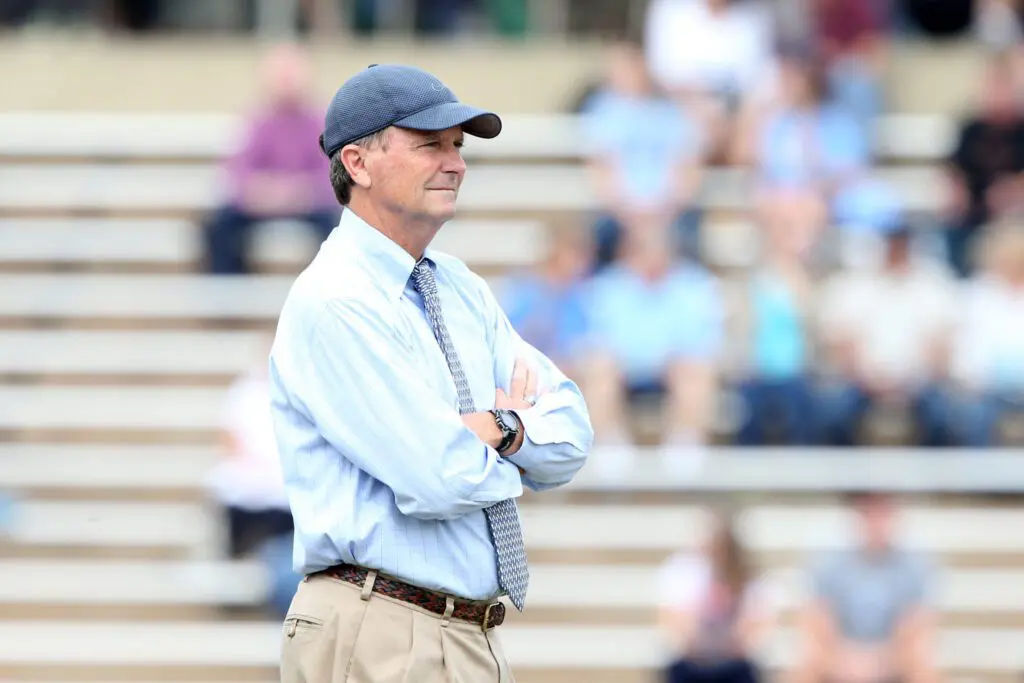
Anson Dorrance is one of the most decorated coaches in the history of sports. Under his direction, the University of North Carolina has won 21 of the 31 NCAA Women’s Soccer Championships. As coach of the USWNT, Dorrance won the first Women’s World Cup in 1991. Below, he spoke with Just Women’s Sports about his experience with the USWNT and his subsequent falling out with US Soccer.
You coached the USWNT to the first Women’s World Cup in 1991. What was special about that team?
What was fabulous about the first Women’s World Cup is that we played a 3-4-3 line-up on the field. Out of the front seven girls, six were extraordinary one-on-one artists and only one of the players in that seven would rather pass the ball instead of dribble through you. The front line was amazing. It was so amazing that the Chinese press called them the ‘triple-edged sword.’ On the left, Carin Jennings would be slicing you up. In the middle was Michelle Akers and on the right was April Heinrichs — all of them extraordinary one-on-one artists.
Then, in the midfield, on the left side was Kristine Lilly and on the right side was Mia Hamm — both could go right through you. Julie Foudy was this wonderful galloping, center midfielder who loved to penetrate off the dribble. Then there was Shannon Higgins, the only girl who liked to pass the ball. She assisted both of Michelle Akers goals in the World Cup final, one off a set piece, one on a through ball. Our foundation was 1 v 1 play but Higgins’ assists were the margin of victory in the final.
Why did you step back from the National Team in 1994?
When I was coaching the National Team, it was a part-time position. They wanted to make it a full-time position for me. I don’t know if you know anything about my history with the National Team, but what’s interesting about those positions is you spend most of your life pulling daggers out of your back. It’s just not that much fun.
Back then, so much of US Soccer was run by voting. You would be voted into this position, voted into that position, and you would politic your way up the ladders in administration. The dilemma with being a national coach back then was that it didn’t matter what roster you picked — you always ended up cutting star players under different state administrators and regional administrators. Immediately, since they are all politicians, they would have each other on speed dial, whining and complaining to US Soccer about all the players I picked. Part of it was very transparent. I picked a lot of UNC players. Why? Because we kicked everyone’s ass in those days. Most of the best players in the country were Tar Heels, but I would never pick a Tar Heel over a player who was better.
For me, coaching the national team was a political nightmare. I never enjoyed it. I also hated being reprimanded by my superiors for not picking the correct teams. I have so many wounds on the top of my back. It’s just one stabbing after another. On the other hand, I loved everything about the University of North Carolina, so that’s what I decided to dedicate my life to.

Was there one specific moment when you decided to leave the National Team?
I was at war with US Soccer from the day I was hired. One year, it was so apparent that all of my critics were lined up against me. We were about to play Germany who, at the time, was the reigning World Champion on the men’s side. They were coming over to play us and all of the US Soccer leaders were so afraid that we were going to get humiliated by the Germans on our home soil that I was attacked by so many different people about the roster I had picked. The criticism I received was embarrassingly hollow. Of the 18 players on the National Team, nine were Tar Heels. Of course, you can see how they were screaming favoritism and blah, blah, blah.
Before we played Germany, there was an Olympic development program where the National Team, the Under-19 National Team and two other teams made up of the best players in the country competed in a tournament. We played round-robin and my National Team beat every one, but the team we had the most trouble with was the U-19 team — we only beat them two to zero. One girl said to me, “Anson, your first team is incredible, but at this point we’re not really competing for a position on the first 11. You have 18 players. What about the bottom seven?” And I thought, that’s completely legitimate criticism.
Now we are in the gold medal game playing the U-19 team again, but we’re starting our entire bench. The team that the starters only beat two to zero, the reserves are now beating nine to zero. I had a philosophy back then to never beat a team by more than nine, so I subbed the starters in and instructed them to just play possession. Well, April Heinrichs was a great captain for me and she knew all of the pressure and criticism I was under — and she wanted to make a statement. She went out and, on a corner kick, ran in from the top of the box and volleyed the ball into the back of the net.
Anyway, that is what’s going on. Now we’re about to play the Germans. We had just finished winning the game against the youth team 10 to zero and the Secretary General for US Soccer came into my locker room and said, “What’s this I hear that you haven’t picked the best team?” I’m thinking to myself, are you kidding me? Did you just watch that game? That was our reserve unit against a team the starters only beat two to zero. I was so mad at the guy.
We proceeded to beat Germany by a wide margin. All of a sudden, the same idiot who challenged me after the 10 to zero victory tried to give me a hug after the Germany game. I said, “Get the hell out of here.” Basically, that was it.
Tony DiCicco took over as head coach for the National Team after you left. How did you feel about that transition?
I don’t know if you’re aware of this but I planned my own successor, which of course, isn’t allowed. The US Soccer President is supposed to pick the National Team coach. I didn’t trust any of them to do that. Basically, I conspired with Tony. I said, “Tony, in this upcoming camp, I’m going to appoint you the National Team coach and tell the players I’m resigning. I’m going to move cones for you but you’re in charge and you’re playing them.” Of course, he was nervous because we weren’t following protocol, but I trusted him.
Here’s the other thing that a lot of people don’t understand. In 1991, going into that World Cup, I told my boss, “Just tell US Soccer at the end of this event, I’m resigning.” He told me, “You can’t do that.” And I said, “Yes, I can. I am never going to give these people the satisfaction of firing me. I’m resigning now and I’m timing it for the last game. If we lose in group play, I resign. If we win the World Championship, I resign.”
I made that very clear to him and, after we won the whole thing, he begged me to stay. I stuck around for another two or three years. Then, Tony and I conspired and when I appointed him head coach, of course, US Soccer was mad as hell but I would never work for them.
They offered me a full-time job but there was no freaking way I was going to put my family in jeopardy by working for them full time. I tried to make a deal with Sunil Gulati [former President of the US Soccer Federation] where I wouldn’t talk to the press or tell them I appointed my own successor. In exchange, I asked him if I could be in charge of player development. I even offered to do it for free. I was afraid that all those political operatives would ruin what we started. He said okay, but then they banned me from US Soccer for 17 years.
Why did they ban you from US Soccer?
Because I appointed my successor.
Did they share that publicly?
No. In fact, you can ask Jill Ellis about it. About 12 or 13 years into my ban, Jill brought me in to help her train the U-20 National Team for a week. So, I went to help and, while I was there, she got a call from Dan Flynn [CEO and Secretary General of US Soccer] chastising her for hiring me to work at the camp. Jill had no idea I had been banned.
Basically, Jill wasn’t allowed to bring me back to the camp anymore once she discovered that I was on the hit list. The irony is that I never threw US Soccer under the bus. I was good. I didn’t criticize any of the coaches they appointed at any level. In fact, I supported them on their mission. I always supported player development. And, obviously, I worked hard to make sure the collegiate game could be a feeding ground for US Soccer.
Were there any other unfortunate run-ins with US Soccer administrators over the years?
While I’m on this US Soccer hit list, I still have things to do. One of my favorite moments came out of the blue. Jürgen Klinsmann read one of my books and loved it. He called me and asked if I wanted to join him in Germany — he was coaching the German men’s national team at the time. I don’t want to pretend that I had anything to do with the German success on that run, but I was there at all the training sessions. I would have breakfast, lunch and dinner with Jürgen. Whenever he flew first class to a game, I was right there next to him. When we were watching Bayern Munich play, I was there in the VIP lounge, dropping caviar into my mouth after my lobster.
To make a long story short, the Germans played the US the week I was there with Jürgen and they beat us by a wide margin, but I’m not sitting in the US section. I’m sitting in the German section. Why? Because I’ve been banned by US Soccer.
I could see Sunil sitting in the US section and he was irate during the game because the Germans were beating the US team. Sunil thought I had something to do with it. I could tell he was angry with me, but I had no issues — every part of that trip for me was first class.
How were you eventually unbanned from US Soccer?
One day, I finally called up Sunil. He wasn’t the one who banned me. Sunil is a friend of mine. He understood and I understood — I’m not allowed to appoint my successor. I didn’t have any issue with that, but I wanted to run player development. So, I called Sunil and asked, “Am I still on your hit list? Am I still banned from US Soccer?” He said, “No, no. We took you off that list a while ago. You’ve suffered enough.” Then, the next year, I won the Werner Fricker award, which is the highest award in US Soccer.
Given your history with US Soccer, what do you think about everything that’s going on now, especially in terms of equal pay initiatives?
Cindy Parlow is the US Soccer President right now and she’s a former player of mine. You are never going to hear any criticism from me. Even when I was banned, all I have ever been critical of are the policies for player development. I think that’s the only area I can speak to because that’s my area of expertise.
I’m not going to speak to equal pay — I’m not qualified. I will certainly speak to player development. Here’s what I know. With Cindy Parlow as US Soccer President, there is no way that they are going to treat the women poorly. I think the direction we’re going to go in with Cindy as President is going to be a wonderful direction. Are we going to solve everything at once? Of course not, but we are going to go in the right direction for the men and the women.
Cindy is going to be a wonderful leader. Keep in mind the people that she has on speed dial — Mia Hamm, Kristine Lilly, Julie Foudy. Her reference book of experts in this game is as long as my arm. I’m actually convinced she’s going to work herself to death. The best thing about Cindy being in this position is that she doesn’t even want it. She is the classic servant leader. I have all the confidence that she’s going to do a good job and that we’re going to go in the right direction.
You mention being critical of the player development policies. How do you think these policies could be changed?
Here’s what drives me a little batshit crazy. We are a dynastic force in women’s soccer, but who is setting the template for player development in the United States? People from Holland. We are the reigning World Champions. We are four-time World Champions. We are four-time Olympic gold medalists. I think the Europeans should be looking to us on the women’s side for player development ideas.
What we really need are genuine leaders at the top who understand how to win the trust of all the people that work for them. The way you win trust is by being transparent and by bringing people into the room to discuss decisions.

Are there any player development policies you feel particularly strongly about?
Substitution. Here’s what’s happening right now, which is sort of interesting. FIFA is going to have a five substitution rule because they are going to have these crammed seasons and they don’t want people to get hurt. I saw an article where everyone was attacking this new rule, but one person said, “You know, once they go to five, they are not going to go back because they are going to discover the value of substitution.”
Obviously, it’s counter-intuitive to think that substitutions are good for player development. Most people think that the way you develop a great player is you put them out there in the field and you don’t substitute them. According to the culture of our game, when you sub someone out, they have to kick buckets and make it look like they’re really pissed — they turn into flaming idiots as they walk towards the bench, avoiding the coach’s handshake and kicking the first water bottle they see. They feel disrespected.
Here’s what is actually true about substitution. You should use substitution as another marker of competition so that you substitute at the point where a fatigued superior player is not as good as a fresh inferior player. The competition for the superior player is to win more time against her touchstone, her counterpart. That’s the competition. The counterpart’s challenge is to eat into the time of the starter.
If you want to motivate players to their potential, you use substitution as a cattle prod. It drives people to stay on the field longer. And, what qualifies you to stay on the field longer is certainly your fitness base. So, those both play into each other.
How have you put that philosophy into practice during your time at North Carolina?
We’ve always done things differently at North Carolina. Of course, we suffer from all kinds of criticism because of the way we do things. I understand that you have to do that, especially if you’re recruiting against us. You have to pretend that substitution is bad for player development. You have to tell these great players that they are going to be subbed if they come to North Carolina.
Here’s the other thing that people don’t understand about these ridiculous substitution rules. Are you familiar with the birth month anomaly? On almost every national team’s roster, the players are born in January, February, March or April. Why? Because they are the oldest in their age group.
As a coach, you only have a certain amount of breath at a practice, so who do you coach? You coach the alphas. You don’t coach the betas. It’s human nature. You coach the ones that are going to help you win the most. It’s not like you dislike the other kids. Great coaches are tied in emotionally and spiritually with everyone on their roster. But if we have a game tomorrow and we’re playing Stanford and I’m talking strategy, I’m not talking to the kid who doesn’t even travel with us. I’m talking to the kids who I’m going to play. That’s human nature.
These players then become the starters. And when the national coaches are looking at players to bring in, they bring in the kids who are playing the most and who are invested in the most.
I can’t remember who I was having this debate with. Maybe it was Sunil or maybe it was one of his minions who thinks they are an expert in player development. On whatever roster I pulled up, the US Women’s National Team had a balance of players born in almost every month. Do you know why? Because in our culture, we substitute. A kid born in December is going to get subbed in and she is going to be hanging on by her freaking fingernails against the player born in January who is twice as big and twice as fast. That little wily kid born in December is going to have to develop a skill set to survive.
Substitution has a positive player development quality. Even Mia Hamm at UNC and Kristine Lilly and Tisha Venturini and Cindy Parlow were all subbed out. Did that interfere with their player development? Did that interfere with Tobin Heath’s player development or Crystal Dunn’s? Hell no.
One of the most wonderful comments made during this past World Cup came from someone who did the math and said, “You know, on the four World Championship US teams, one out of three players on all four rosters was a Tar Heel.”
Thank you. You know how we did it? We did it by substituting.